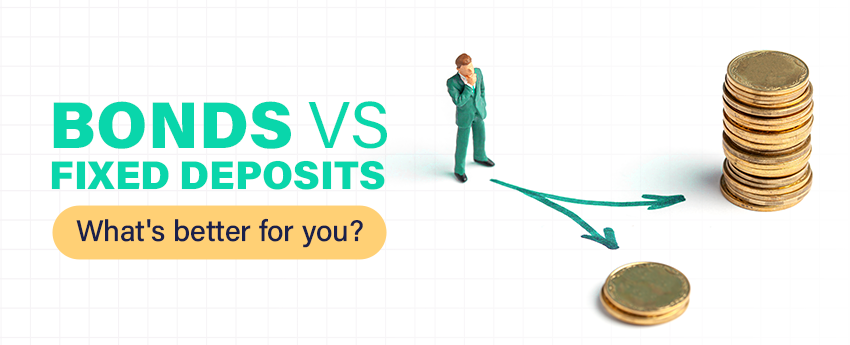
Bonds vs Fixed Deposits: Which Will Reign Supreme in 2024 for Risk-Averse Investors?
The investment playground is a very interesting place, comprising diverse investors with distinct investment objectives and risk appetites. While some are prepared to soar or take the plunge with risky investments, many play it safe. If you are one amongst the latter, you aren’t alone. And there’s nothing wrong with being risk-averse. Everyone is an individual player with unique financial goals and has the right to make choices.
However, what confronts many of the risk-averse investors is the choice between investment avenues. Two of the most common contenders in this regard include bonds and fixed deposits. Both are considered reliable, secure, and stable. But which one to choose and will emerge triumphant in 2024? Let’s attempt to answer this question.
What are Bonds?
Bonds are debt securities or fixed-income instruments signifying a loan from an investor (bondholder) to a borrower (bond issuer). It is a contract between the investor and the issuer. The latter raises the bond to raise funds to fulfill its objectives like operational funding, territorial expansion, foreign projects, equipment purchase, etc. It pays returns in the form of periodic interest payments and principal return upon the bond’s maturity.
Usually, entities issuing a bond include central governments, state governments, municipalities, corporate companies, NBFCs, and others. Each one issues a bond to raise capital for its distinct objectives and pays varying interest rates.
Now, having understood the concept of bonds, let’s look at fixed deposits.
What are Fixed Deposits?
Conventional and very well-known across the Indian investment horizon, Fixed Deposits are considered one of the most reliable investment instruments by Indians. They are also known as term deposits, requiring individuals to invest a lumpsum amount for a particular period with a bank. The amount the investor deposits helps them earn interest at a fixed rate, determined at the time of opening of the fixed deposit account. Investors investing in fixed deposits can choose to earn interest monthly, quarterly, half-yearly, or annually, based on their individual investment preferences and goals.
When an investor opens a fixed deposit account, they deposit a specific amount for a particular period, which could be six months, a year, two years, five years, etc. The amount remains in the account for the said period until the fixed deposit’s maturity. The longer the investment period, the higher the interest rate and earnings. Ideally, the investor shouldn’t withdraw the money from the fixed deposit until maturity. However, if required, they can do so, albeit at a penalty or loss of interest.
Once the fixed deposit matures, the money (principal + interest (if chosen to receive upon the fixed deposit’s maturity) is either reinvested or credited back to the holder’s account, depending on their instructions or preferences.
Difference Between Bonds and Fixed Deposits
Let’s look at some significant differences between bonds and fixed deposits to determine which one is a more investor-friendly investment instrument.
|
Parameter |
Bonds |
Fixed Deposits |
|
Issuer |
Entities like governments, corporations, etc. issue bonds to raise funds for their financial goals. Thus, when someone buys a bond, they lend money to the issuer and receive periodic interest payments and the principal amount upon maturity. |
Fixed deposits are usually investment products of banks and other financial institutions. When an individual invests in a fixed deposit, they keep the amount as a deposit for a specific period and pre-determined interest rate. |
|
Interest Rates |
Bonds can offer fixed or floating interests, depending on the type of bond the bondholder chooses. |
Fixed deposits offer a fixed rate for a particular tenure. The bank determines the interest rate and informs it to the investor at the time of opening the deposit. |
|
Tradability |
You can trade bonds in the secondary market. It means, you can buy or sell bonds in the secondary market before their maturity date. |
You cannot trade fixed deposits in the open market. All you can do is invest your money as a deposit with a bank or a financial institution. |
|
Liquidity |
Bonds offer more liquidity than fixed deposits. You can buy and sell them in the secondary market before maturity. Furthermore, their prices fluctuate depending upon changes in the market and its conditions. |
Fixed deposits aren’t as liquid as bonds. Usually, they come with a fixed tenure. However, banks or financial institutions allow investors to withdraw them partially or in full before the maturity date at a penalty or interest loss. |
|
Risk Involved |
Risk levels in case of bonds vary with the type of bond you choose. For example, government bonds are usually considered safer and more reliable to invest. But corporate bonds, depending on the company’s credit rating, can be deemed more or less risky. Additionally, bond prices can change based on interest rate variations and the issuer’s creditworthiness. |
Fixed deposits are less risky than bonds. It is because they have the bank’s security with them and are usually immune to market ups and downs. It means, based on the fixed deposit type you choose, the interest rate and your principal amount remains unchanged. |
|
Taxation |
Taxability on the income earned through a bond depends on the bond type chosen and the local tax implications. Some government bonds have tax benefits associated with them. |
The interest you earn on fixed deposits is taxable per the Income Tax Act, 1961, as it is considered income from other sources. |
|
Minimum Investment Amount |
A few bonds may have a minimum investment requirement, particularly if the issuer is the government or a massive company. |
You can start with an amount as little as Rs. 5,000 depending on the minimum amount requirement of the bank. Hence, fixed deposits are more accessible for small investors. |
|
Maturity Period |
The maturity period of bonds varies from short-term to long-term. For example, a few bonds mature in a few months, while some others may take five, ten or even twenty years. |
Fixed deposits also have fixed tenure, which can be decided by the investor while depositing money in the fixed deposit account. It could be as little as seven days to ten years. |
Are Bonds Really a Secure Investment?
Bonds can serve as a secure investment instrument, provided you invest in the right bond with a high rating. Of course, bonds with organizations carrying a high rating usually offer a lower interest rate. However, the organization’s stability and credibility compensate for the low-interest rate. Thus, although the returns may not be as exciting as equity and stocks, you’d stay assured about a fixed and stable income until the bond’s maturity. Besides, your principal amount would remain unchanged.
So, fixed-period interest payments and repayment of the full principal amount make bonds a secure investment.
Now, is there a risk involved in bond investments? Yes. No investment instrument is fully secure. Some element of risk always persists. In the case of bonds, especially corporate ones, you cannot fully eliminate the risk of the company defaulting on principal payment at maturity. Thus, the key to successful bond investments is investing in high-rated and creditworthy organizations. Seeking expert assistance can help you navigate the options and choose the right one for your investment objectives.
How Reliable are Fixed Deposits as an Investment Avenue?
Fixed deposits are also considered a secure investment choice. Here, the risk of default is significantly low. Further, you receive a fixed interest periodically (based on the time interval you choose) and keep your principal amount secure. However, it should be noted that many fixed deposits do not keep up with the national inflation rates. If the inflation rate outscores the interest, you may lose more money than you earn.
Bonds vs Fixed Deposits – Which One Can Emerge as the Podium Winner?
We think it is bonds that score a little higher than fixed deposits. Some areas where we think bonds emerge as a clear winner include tradability, interest rates, and overall earning potential. It isn’t that fixed deposits aren’t a worthwhile investment option. However, experts recommend diversifying the investment portfolio and keeping a healthy balance of fixed deposits, bonds and other investment instruments to spread the risk and maintain the income earned.
Sign up with Altifi if you feel intrigued by bonds and want access to reliable bond options apt for risk-averse investors.
Disclaimer: The contents of this article should not be construed as tax or financial advice. Readers should seek advice from their tax or financial advisor before making any investment decision.