“Successful investing is about managing risk, not avoiding it”: Benjamin Graham.
The shadow of ‘risk’ is lurking everywhere be it life or in investing. The investment landscape has a large canvas of risk starting with the extremely high-risk investments such as the unregulated world of Cryptocurrencies at one end to safe investments such as bonds guaranteed by the sovereign. Somewhere within the spectrum is equities with high-risk associated and plethora of debt instruments bonds with varying degree of risk.
Yes, you read it right. Debt instruments carry a fair degree of risk. Most fixed income investors are risk-averse and invest in debt to avoid sudden, unpleasant hits to their portfolio.
Types of risk:
An investment in a bond is typically exposed to three main types of risk - credit risk, liquidity risk and interest rate risk.
Credit risk is a crucial parameter for a bond and understanding it is beneficial for every investor wanting to invest in a range of debt instruments. Credit risk simply denotes the possibility of an issuer of a bond not paying the interest or principal or both on the due date as per the terms of the bond. In India this is very much evident in the past when some of the issuers failed to honor their commitments to the investors.
Liquidity risk is an uncertainty over being to sell the instruments when one needs money. Many bonds are thinly traded and cannot be easily sold to create liquidity.
On the other hand, interest rate risk refers to the impact of changes in the overall interest rate environment on the debt instrument. This has direct impact on the price of the instrument. As is evident in recent years, interest rates globally have witnessed a cycle of gradual lowering, followed by the current cycle of central banks across the world raising interest rates to tame the raging inflation. For investors who intend to hold their bonds till maturity, liquidity and interest rate risk have no impact.
In this article we look at how credit risk impacts debt and how you can understand it to make the most from your investments.
How credit rating helps:
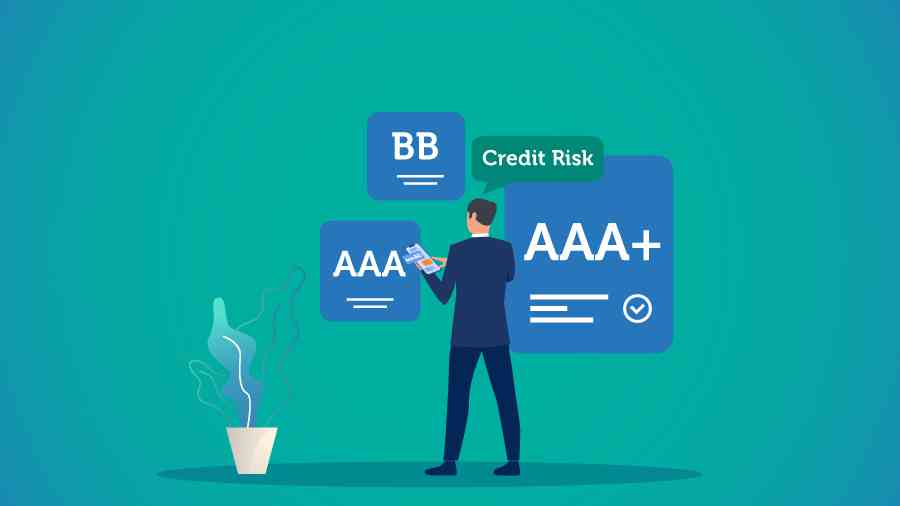
Credit rating is a mechanism to help investors understand the overall risk level associated with debt offering. Debt issuers approach credit rating companies to measure this credit risk associated with each of the bonds. The bonds with the highest of safety of repayment of principal and interest, in the credit rating agency’s opinion, are AAA rated. As the credit risk goes up, the rating changes to lower levels such as AA+, AA, A, A+, BBB and so on. A debt instrument assigned ‘C’ rating carries very high risk for investors while a ‘D’ signifies imminent default.
However, it is important to note that credit rating agencies operate within fixed frameworks and this may sometimes prevent them from assessing the risk accurately. They can err on both sides – either being too generous or conservative in their opinions. This leads to opportunities to exploit the arbitrage between perceived risk and real risk. Many institutional lenders and investors have their own credit teams to assess the risk involved and exploit this arbitrage. Retail investors can also take advantage of this scenario by investing in bonds that have been curated by experts.
Impact of rating changes:
Credit ratings are issued for short term debt as well as long term debt of the issuer. Ratings are periodically reviewed by rating agencies with rating changes indicating altered fundamentals of the issuer. If a bond’s credit rating improves, the price of the bond in the secondary market goes up, with less risk visible and vice-versa. Investors would notice that the net asset value (NAV) of a mutual fund schemes holding bonds change when an instrument with sizable allocation undergoes a change in credit rating.
Improving returns:
Taking the right credit risk can enhance one’s portfolio returns. A relatively low credit rating means the coupon payments are higher compared to AAA rated bonds. Thus, an inverse relationship exists here: The higher the rating, the lower the returns. Take the simple case of credit risk funds. These mutual fund schemes invest a minimum of 65 percent of their corpus in bonds with credit rating less than AA+. These schemes are expected to offer better returns than schemes holding AAA rated bonds.
Savvy investors with greater risk-taking ability can implement this strategy in their personal portfolio by choosing to invest in bonds with lower rating. In times of high inflation, when the rate of real yield (nominal rate of interest minus inflation) is negative, investments in high coupon bonds can save the fixed income portfolio. However, since these bonds come with elevated risk, investors need to be careful by performing adequate diligence, relying on advisors or choosing curated securities vetted by experts.
Diversify your allocation:
At the overall portfolio level the allocation to such bonds needs to be decided. Also, once the overall allocation is decided, a smart investor should ensure that not all of it is invested with one issuer or issuers from one sector. This diversification helps in case of an adverse development and reduces concentration risk.
An eye on liquidity:
It may be difficult to find buyers of bonds with AA, A and BBB ratings in the secondary market. Hence, they enjoy low demand in the secondary market and may not always trade near fair value. Investors taking exposure to these bonds, hence, ideally prefer to hold on to them till maturity.
Secured vs unsecured:
Some investors are keen to only invest in low rated bonds only to the extent of secured offerings, while the more aggressive lot may choose to invest in unsecured ones. Secured bonds have some underlying assets as collateral which may be monetized to pay off the bond holders in case of bankruptcy filed by the issuer.
Timing the market:
Investors keen on outperformance often keep track of the bond market to time their investments. In distress situations, or times of low liquidity, bonds are available at attractive prices. Investing in those times ensures better yields. However, there are some process-driven investors, who prefer to do it in a disciplined manner and ladder their investments. They buy bonds across maturities through the bond platforms. This means that they reduce the risk of investing all their money at a peak or bottom of the interest rate cycle.
Managing credit risk can thus help investors generate better returns than most average investors.
Team Altifi.