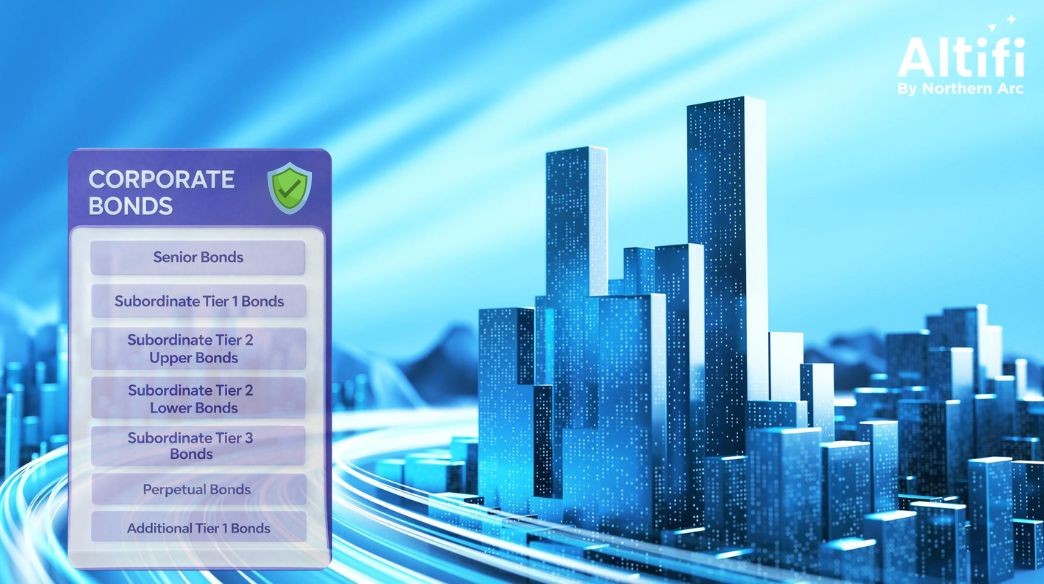
Most people first hear about corporate bonds only after they’ve spent years investing elsewhere. Stocks feel exciting. Fixed deposits feel familiar. Bonds usually sit somewhere in between quiet, practical, and easy to ignore. Until you realise they’re doing a lot of work behind the scenes.
At a very basic level, a corporate bond is not complicated. A company needs money. Instead of taking a bank loan or issuing shares, it borrows directly from investors. In return, it agrees to pay interest and return the money after a fixed period.
That’s it.
Where things start to matter is how that borrowing is structured. Because not all corporate bonds behave the same way, and not all of them carry the same level of risk.
What a Corporate Bond Actually Is
When you buy a corporate bond, you are lending money to a company for a defined period.
In exchange, the company mentions:
- regular interest payments (monthly, quarterly, or annually)
- repayment of your principal on a specific maturity date
Companies use this money to expand capacity, fund projects, refinance old debt, or manage cash flows. Investors use bonds to generate income and add stability to their portfolios.
Types of Corporate Bonds Based on Security
Corporate bonds can be categorised according to their repayment priority and the security that underpins them.
- Secured Bonds: These bonds are backed by assets of the corporation. The pledged assets may be utilised to satisfy repayment obligations in case of the issuer defaults.
- Unsecured Bonds (debentures): These bonds are not secured by any specific security. Repayment is contingent upon the issuer's financial stability and capacity to fulfil commitments.
Types of Corporate Bonds Based on Repayment Priority
Here are the types of corporate bonds based on their repayment priority.
- Senior Bonds: During repayment, these bonds have a greater claim on corporate assets. Subordinated debt holders are often paid after senior bondholders.
- Subordinated Bonds: In the system of repayment, these bonds are ranked lower than senior debt. After paying higher-priority creditors, repayment is typically made.
Types of Corporate Bonds Based on Equity Features
Some corporate bonds include provisions that are linked to company shares.
- Partly Convertible Bonds: A portion of the bond can be exchanged into equity shares of the issuing company. The remaining portion continues as a regular debt instrument until maturity.
- Mandatory Convertible Bonds: These bonds automatically convert into shares on a specified date. The conversion takes place according to conditions mentioned in the issue documents.
Types of Corporate Bonds Based on Conversion Features
Some corporate bonds have different conversion rules.
- Convertible Bonds: Under certain conditions, these bonds may be convert for equity shares. At the time of issuance, the conversion price and ratio are determined.
- Non-Convertible Bonds: These bonds are not convertible into equity shares. According to the bond terms, investors get principal and interest payments.
Types of Corporate Bonds Based on Interest and Redemption Structure
Corporate bonds may also vary in terms of how interest is paid and how maturity is defined.
- Fixed Rate Bonds: These are bonds that pay a fixed rate of interest over the term of the bond. The coupon rate is fixed regardless of what happens to the market interest rate.
- Floating Rate Bonds: These bonds have changed interest rates. The rate is generally linked to a benchmark or reference rate.
- Zero Coupon Bonds: There are no monthly interest payments on these bonds. They sell at a discount on the face value and redeem at face value upon maturity.
- Callable Bonds: The issuer can repay these bonds before maturity.
- Puttable Bonds: These bonds give investors the option to sell them back early. The exercise conditions are defined when the bonds are issued.
- Perpetual Bonds: These are bonds that have no set maturity date. Interest payments are expected to continue as long as the issuer is liable.
Bonds Based on Maturity
Time horizon changes how a bond behaves.
- Short-term bonds (1–3 years): Lower volatility, easier exits
- Medium-term bonds (4–10 years): Balanced risk and return
- Long-term bonds (10+ years): Higher yields, but more sensitive to interest rate changes
Matching maturity to your financial goals is often more important than chasing yield.
Choosing the Right Corporate Bond
There’s no universally “best” bond. The right one depends on context.
- How much risk can you actually tolerate?
- Do you need regular income or future lump sums?
- How comfortable are you holding till maturity?
- Can you exit easily if needed?
- Good bond investing is usually about balance, not bravado.
Conclusion
Corporate bonds may serve as a suitable instrument for regular income. They may offer cash flows, defined maturity periods, and varying risk profiles depending on issuer quality and structure. Understanding bond categories, credit strength, and investment horizon helps improve decision-making and reduces exposure to unnecessary risk. A disciplined approach ensures alignment with financial goals, liquidity needs, and risk tolerance. When used appropriately, corporate bonds may contribute to portfolio stability and long-term financial planning outcomes.
FAQs
Are corporate bonds safe?
They may be relatively less volatile than equities but riskier than government bonds. It depends on the issuer and bond structure.
How much do corporate bonds pay?
Typically between 8% and 12%, depending on credit quality and maturity.
What happens at maturity?
You receive your principal back along with the final interest payment.
Corporate bonds or government bonds which is better?
Government bonds may be relatively less volatile. However, corporate bonds may offer relatively higher income. The suitability depends on your risk appetite and investment goals.
What is the minimum investment amount?
Many corporate bonds are available from ₹10,000.
Disclaimer:
The information contained in this Article (“Article”) is for general informational purposes only. Northern Arc Capital Limited (“Northern Arc”) does not make any warranties about the completeness, reliability, and accuracy of this information. Any action you take upon the information contained in this Article is strictly at your own risk, and Northern Arc will not be liable for any losses and damages in connection with the use of our Article.
The data included in this Article has been obtained from sources that are believed to be reliable and accurate at the time of publication. However, Northern Arc does not guarantee the accuracy or completeness of any information, nor does it assume any responsibility or liability for any errors or omissions therein. Any opinions expressed herein are subject to change without notice and Northern Arc is under no obligation to update or keep current the information contained in this Article.
This Article is not intended to constitute, and should not be construed as, investment advice or a recommendation to purchase, sell, or hold any security or to engage in any investment strategy or transaction. Readers should not rely solely on the information provided in this Article for making investment decisions and should conduct their own due diligence or seek the advice of a qualified professional.
The content of this Article is for informational purposes only and is not a solicitation or an offer to buy or sell any securities or financial instruments. Northern Arc is not responsible for any investment decisions made by the recipients of this Article. Readers should take independent financial advice from a qualified professional in connection with, or independently research and verify, any information that is provided in this Article and wish to rely upon, whether for the purpose of making an investment decision or otherwise.
Northern Arc and its affiliates, directors, employees, and agents expressly disclaim any and all liability for any direct or indirect losses, damages, or expenses of any kind arising out of or relating to the use of this Article, including but not limited to, any losses related to the accuracy, completeness, timeliness, or reliability of such information.
This Article may contain forward-looking statements that are based on current expectations, estimates, forecasts, and projections about the markets in which Northern Arc operates, as well as management’s beliefs and assumptions. Forward-looking statements are not guarantees of future performance and involve certain risks and uncertainties, which are difficult to predict. Past performance is not indicative of future results.
This report is intended solely for the recipient and is not for further circulation. Any distribution, modification, reproduction, or disclosure of the contents of this Article, in whole or in part, without the prior written consent of Northern Arc, is strictly prohibited.