When planning personal finances, one question quietly shapes many decisions: How predictable is my cash flow?
For salaried professionals, retirees, and conservative investors alike, the choice often comes down to two familiar fixed-income options Fixed Deposits (FDs) and Bond Laddering.
At first glance, both promise stability. But when you look closer especially through the lens of cash flow planning their outcomes can differ meaningfully over time.
This article breaks down the cash flow dynamics of Fixed Deposits versus Bond Ladders, using real-life style scenarios, 1-year and 5-year comparisons, and practical planning perspectives to help you decide what works better for your financial goals.
Why Cash Flow Matters More Than Returns Alone
Most investors focus on interest rates. But returns are only part of the story. What truly affects daily financial comfort is when money becomes available and how consistently it flows.
Good cash flow planning helps:
- Cover recurring expenses
- Fund short-term goals without selling investments
- Reduce dependence on emergency withdrawals
- Smooth income during rate cycles
This is where the structure of an investment matters as much as its yield.
Understanding the Two Options
What Is a Fixed Deposit?
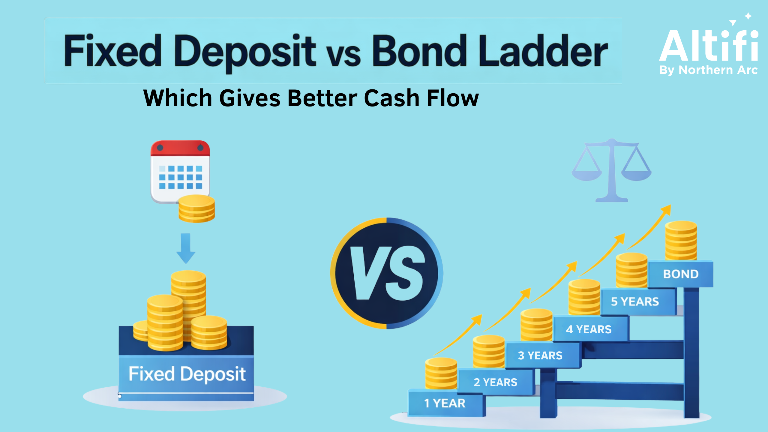
A Fixed Deposit is a lump-sum investment locked in for a fixed tenure commonly 1 to 5 years earning a predetermined interest rate. Interest may be paid monthly, quarterly, annually, or at maturity.
Cash flow nature:
Predictable, but typically front-loaded or back-ended, depending on payout
choice.
What Is Bond Laddering?
Bond laddering involves investing in multiple bonds with staggered maturities. Instead of putting all money into one tenure, you spread it across different timelines say 1, 2, 3, 4, and 5 years.
Each year, one bond matures, releasing principal and interest, which can be:
- Used as income
- Reinvested at prevailing rates
- Redirected toward goals
Cash flow nature:
Regular, rolling, and adaptive.
Case Study 1: 1-Year Horizon — Short-Term Cash Needs
Scenario
Ravi, age 35, wants to park ₹5 lakh for one year to:
- Keep money safe
- Earn some return
- Ensure access if needed for a planned expense
Option A: 1-Year Fixed Deposit
- Investment: ₹5,00,000
- Tenure: 1 year
- Interest payout: At maturity
Cash flow experience:
- No inflow during the year
- One lump-sum inflow at maturity
Pros:
- Simple
- Predictable return
Cons:
- No interim liquidity without penalty
- No flexibility if rates rise mid-year
Option B: Mini Bond Ladder (3–6–12 months)
Ravi splits ₹5 lakh into:
- ₹1.5 lakh (3-month bond)
- ₹1.5 lakh (6-month bond)
- ₹2 lakh (12-month bond)
Cash flow experience:
- Cash inflow at 3 months
- Cash inflow at 6 months
- Final maturity at 12 months
Outcome:
- Liquidity at multiple points
- Option to reinvest or withdraw partially
Verdict for 1-Year Planning
For short-term parking, Fixed Deposits work well if
liquidity is not required.
However, even a simple ladder improves flexibility without sacrificing
stability.
Winner for cash flow: Bond ladder (by structure)
Case Study 2: 5-Year Horizon — Income & Stability Planning
Scenario
Meera, age 55, is planning for semi-retirement. She wants:
- Predictable cash flow
- Minimal reinvestment stress
- Protection against rate fluctuations
Investment amount: ₹10 lakh
Time horizon: 5 years
Option A: 5-Year Fixed Deposit
- Entire ₹10 lakh invested at once
- Interest payout: Monthly
Cash flow pattern:
- Same interest amount every month
- Principal locked for full tenure
What works well:
- Easy monthly income
- No active management
Limitations:
- If interest rates rise after year 1, income stays unchanged
- Principal unavailable without penalty
- Reinvestment risk at maturity (rate uncertainty)
Option B: 5-Year Bond Ladder
Meera splits ₹10 lakh into:
- ₹2 lakh each in bonds maturing at years 1, 2, 3, 4, and 5
Cash flow pattern:
- One bond matures every year
- Annual principal inflow
- Regular coupon income from remaining bonds
Advantages:
- Built-in liquidity every year
- Ability to reinvest at prevailing rates
- Reduced reinvestment risk
- Cash flow becomes smoother over time
Year-by-Year Comparison
Year |
FD Cash Flow |
Bond Ladder Cash Flow |
|
1 |
Interest only |
Coupon + 20% principal |
|
2 |
Interest only |
Coupon + 20% principal |
|
3 |
Interest only |
Coupon + 20% principal |
|
4 |
Interest only |
Coupon + 20% principal |
|
5 |
Interest + full principal |
Coupon + final principal |
Verdict for 5-Year Planning
- Fixed Deposit: Static income
- Bond Ladder: Dynamic, adaptive cash flow
Winner for cash flow resilience: Bond ladder
Interest Rate Cycles: The Hidden Cash Flow Factor
Interest rates rarely stay constant for five years.
In a Rising Rate Environment
- FD investors stay locked at lower rates
- Bond ladder investors reinvest maturing bonds at higher yields
In a Falling Rate Environment
- Longer bonds in the ladder lock higher rates
- FD renewals face lower reinvestment returns
Bond laddering naturally balances rate cycles, protecting long-term cash flow stability.
Liquidity & Emergency Planning
Feature |
Fixed Deposit |
Bond Ladder |
|
Early exit |
Penalty |
Natural maturity |
|
Partial withdrawal |
Difficult |
Possible annually |
|
Emergency access |
Costly |
Planned |
For financial planning, planned liquidity beats forced liquidity an area where ladders excel.
Tax Planning Perspective (High-Level)
- FD interest is taxed annually
- Bond interest taxation depends on structure and holding period
- Laddering allows tax events to be spread over years, aiding smoother planning
(Always consult a tax professional for personalised guidance)
Who Should Prefer Fixed Deposits?
Fixed Deposits may suit:
- First-time investors
- Very short-term goals
- Those seeking absolute simplicity
- Investors uncomfortable managing reinvestments
Who Should Prefer Bond Laddering?
Bond laddering works well for:
- Income-focused investors
- Retirement planning
- Rate-cycle uncertainty
- Long-term financial planning
- Investors who value liquidity without penalties
Key Takeaway: Cash Flow Is About Timing, Not Just Yield
A Fixed Deposit answers one question well:
How much will I earn?
A Bond Ladder answers a better one:
When will my money work for me—and when will I need it?
For serious financial planning, predictable access often matters more than headline returns.
Final Verdict
- 1-Year Horizon: FD works, ladder offers flexibility
- 5-Year Horizon: Bond ladder provides superior cash-flow management
- Overall: Bond laddering aligns better with long-term planning and income predictability
Frequently Asked Questions (FAQs)
1. Is bond laddering risky compared to fixed deposits?
Bond laddering reduces reinvestment and timing risk through diversification
across maturities, though credit quality must be assessed carefully.
2. Can bond laddering provide monthly income?
Yes, through staggered coupon payments combined with annual maturities.
3. Is bond laddering suitable for retirees?
Yes, especially for retirees seeking predictable income with periodic
liquidity.
4. What is the minimum amount needed for bond laddering?
It depends on available instruments, but laddering can be structured even with
moderate amounts through careful allocation.
5. Can I combine FD and bond ladder strategies?
Yes. Many investors use FDs for short-term needs and ladders for long-term
planning.
Disclaimer:
The information contained in this Article (“Article”) is for general informational purposes only. Northern Arc Capital Limited (“Northern Arc”) does not make any warranties about the completeness, reliability, and accuracy of this information. Any action you take upon the information contained in this Article is strictly at your own risk, and Northern Arc will not be liable for any losses and damages in connection with the use of our Article.
The data included in this Article has been obtained from sources that are believed to be reliable and accurate at the time of publication. However, Northern Arc does not guarantee the accuracy or completeness of any information, nor does it assume any responsibility or liability for any errors or omissions therein. Any opinions expressed herein are subject to change without notice and Northern Arc is under no obligation to update or keep current the information contained in this Article.
This Article is not intended to constitute, and should not be construed as, investment advice or a recommendation to purchase, sell, or hold any security or to engage in any investment strategy or transaction. Readers should not rely solely on the information provided in this Article for making investment decisions and should conduct their own due diligence or seek the advice of a qualified professional.
The content of this Article is for informational purposes only and is not a solicitation or an offer to buy or sell any securities or financial instruments. Northern Arc is not responsible for any investment decisions made by the recipients of this Article. Readers should take independent financial advice from a qualified professional in connection with, or independently research and verify, any information that is provided in this Article and wish to rely upon, whether for the purpose of making an investment decision or otherwise.
Northern Arc and its affiliates, directors, employees, and agents expressly disclaim any and all liability for any direct or indirect losses, damages, or expenses of any kind arising out of or relating to the use of this Article, including but not limited to, any losses related to the accuracy, completeness, timeliness, or reliability of such information.
This Article may contain forward-looking statements that are based on current expectations, estimates, forecasts, and projections about the markets in which Northern Arc operates, as well as management’s beliefs and assumptions. Forward-looking statements are not guarantees of future performance and involve certain risks and uncertainties, which are difficult to predict. Past performance is not indicative of future results.
This report is intended solely for the recipient and is not for further circulation. Any distribution, modification, reproduction, or disclosure of the contents of this Article, in whole or in part, without the prior written consent of Northern Arc, is strictly prohibited.