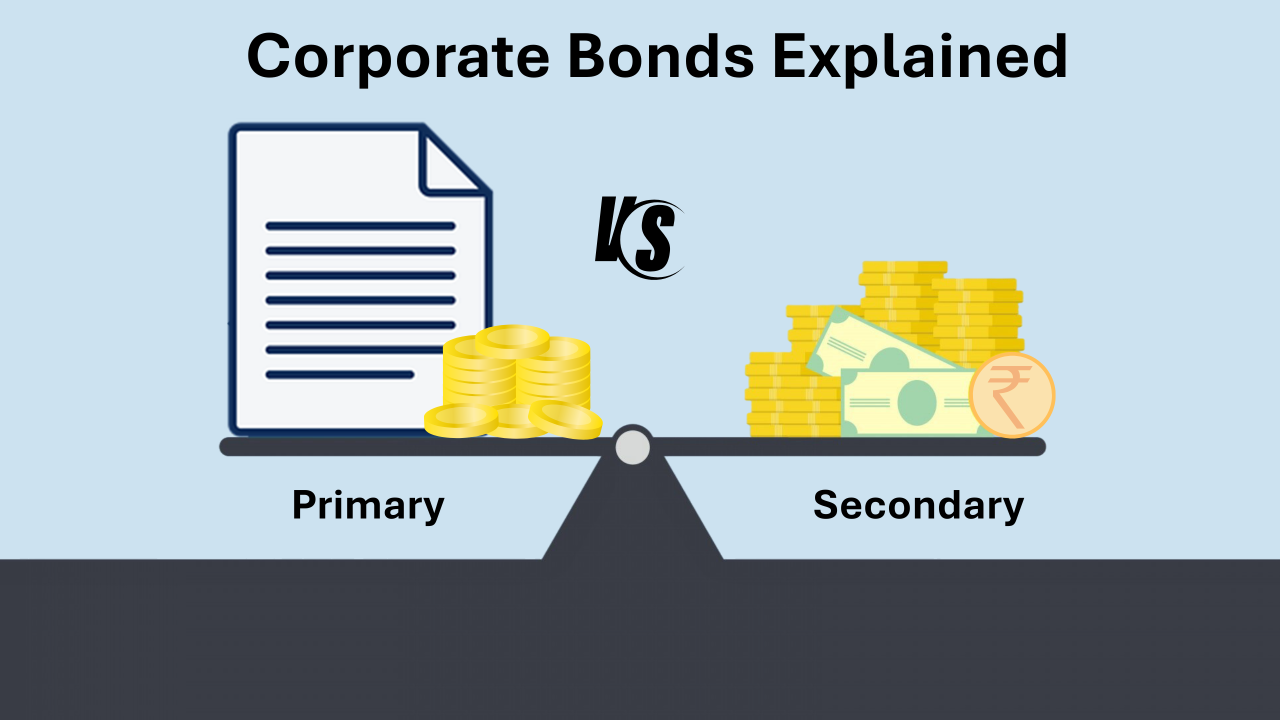
Understanding how the bond market functions is essential for anyone exploring fixed-income investing in India. Bonds help corporations and governments raise capital while providing investors with predictable income and portfolio stability. The Indian bond market has expanded rapidly in recent years, supported by digital platforms, regulatory clarity, and growing retail participation.
Within this market, the primary and secondary bond segments serve distinct purposes. The primary market facilitates the initial issuance of bonds, while the secondary market enables trading among investors after issuance. Both markets contribute to liquidity, transparency, and price discovery across the debt ecosystem.
This guide explains the structure and purpose of each market, highlights the key differences, and embeds helpful resources for deeper reading.
Key Takeaways
- The primary market is where new bonds are issued; the secondary market is where existing bonds trade between investors.
- Primary bonds are typically issued at face value, whereas secondary bonds are priced according to market dynamics.
- Important considerations include credit ratings, interest rate outlook, liquidity needs, and taxation.
- Digital platforms and marketplaces have expanded retail access to both primary and secondary opportunities.
For foundational concepts, see What is a
Bond?.
What is the Primary Bond Market?
The primary market is where issuers corporations, government authorities, and financial institutions offer bonds for the first time to raise capital. Funds raised may finance infrastructure, expansion, refinancing, or working capital.
Key characteristics:
- First-time issuance: Bonds are sold directly to investors at launch.
- Face-value pricing: Initial subscriptions generally occur at par, simplifying yield calculations.
- Structured documentation: Issuers provide offer documents, rating details, and repayment terms.
- Time-limited availability: Offers are open for a defined subscription window.
Primary issuance commonly includes Corporate Bonds
and Government
Securities.
What is the Secondary Bond Market?
After issuance, bonds move into the secondary market, where
investors buy and sell existing securities among themselves. Digital platforms
like altifi.ai have made
participation easier, providing retail investors with access and transparent
information.
Key characteristics:
- Market-driven pricing: Prices fluctuate based on interest rates, credit updates, and time to maturity.
- Liquidity and exit options: Investors can sell bonds before maturity.
- Continuous trading opportunities: The secondary market operates based on ongoing supply and demand.
- Access to older issuances: Bonds no longer available in the primary market can be traded here.
For structured investment options and non-convertible
debenture offerings, see NCD-IPO.
Primary vs Secondary: Structured Comparison
Feature |
Primary Market |
Secondary Market |
Purpose |
Capital raising |
Trading & liquidity |
Pricing |
Usually at face value |
Market-driven |
Timing |
Limited subscription window |
Continuous availability |
Issuer role |
Active seller |
Not directly involved |
Liquidity |
Relatively limited initially |
Potentially higher, varies by bond |
Understanding this structure helps investors choose instruments that align with
their objectives whether predictable income from a fresh issue or trading
flexibility in the secondary market.
Factors Influencing Market Behavior
Interest Rate Environment
Interest rate movements are central to bond pricing. When rates rise, secondary market prices typically decline; when rates fall, existing bonds with higher coupons may appreciate.
Credit and Ratings
Credit ratings signal an issuer’s repayment capacity. Downgrades or upgrades can significantly affect secondary market prices and investor demand.
Supply and Issuance Calendar
Large government borrowing programs or corporate issuance schedules influence yields across the curve and affect both primary allocations and secondary liquidity.
Liquidity and Investor Demand
Highly rated, widely distributed bonds tend to be more liquid in the secondary market. Niche or lower-rated issues may be harder to trade.
How Investors Typically Use Each Market
- Primary
market: Suitable for investors seeking direct access to new issues
with predictable coupon schedules. Institutional investors and retail
participants who intend to hold until maturity often prefer primary
subscriptions.
- Secondary market: Enables flexible entry or exit, tactical repositioning, or immediate exposure to specific maturities or yields. It also allows investors to buy bonds at discounted prices or sell early.
Practical Considerations Before Participating
Define Investment Horizon
Match bond maturities to cash-flow needs. Shorter tenors reduce interest-rate sensitivity; longer tenors increase potential price volatility.
Check Credit Quality
Review rating agency opinions and issuer financials. High-rated Corporate Bonds and Government Securities provide better repayment assurance.
Evaluate Liquidity Needs
Primary bonds may have limited liquidity before listing. Secondary bonds allow earlier exit options.
Understand Taxation
Interest income is taxable per applicable slabs, and capital gains rules vary with holding periods and listing status.
For additional insights and ongoing commentary, visit Blogs.
How Primary and Secondary Markets Strengthen India’s Bond Ecosystem
Both markets complement each other: the primary market ensures continuous capital formation, while the secondary market enhances liquidity, transparency, and price discovery. Together, they provide a robust environment where investors can align strategies with their objectives, risk appetite, and market timing.
Conclusion
Primary Bonds vs Secondary Bonds perform distinct but interconnected roles in India’s fixed-income landscape. The primary market is crucial for capital raising, offering structured, predictable returns, while the secondary market provides liquidity and trading flexibility. Understanding these differences allows investors to make informed choices, balancing long-term stability with short-term opportunities.
Educational resources and curated platforms like altifi.ai help investors navigate bond options, explore Corporate Bonds, Government Securities, and participate in NCD-IPO listings—all while leveraging insights from Altifi Blogs for deeper understanding.
FAQs on Primary vs Secondary Bonds
1. What is the main difference between primary and
secondary bonds?
Primary bonds are purchased directly from the issuer at issuance, usually at
face value, while secondary bonds are traded among investors after issuance
with prices determined by market conditions.
2. Which market is more liquid?
The secondary market generally offers higher liquidity, allowing investors to
buy or sell bonds before maturity. Primary market bonds have limited liquidity
until they enter the secondary market.
3. Can retail investors participate in primary bond issues?
Yes. Retail investors can access primary bond issues through regulated
platforms like altifi.ai, stock
exchanges, and some financial institutions.
4. How does interest rate movement affect these markets?
Rising interest rates can reduce secondary bond prices, while falling rates can
increase their market value. Primary bonds have fixed rates, so their returns
are more predictable at issuance.
5. Are all corporate bonds available on the secondary market?
Not all bonds may be actively traded. Highly rated corporate bonds and
government securities tend to be more liquid. For structured new issues, refer
to NCD-IPO
listings.
Disclaimer:
Investments in debt securities/municipal debt securities/securitized debt instruments are subject to risks including delay and/or default in payment. Read all the offer-related documents carefully.