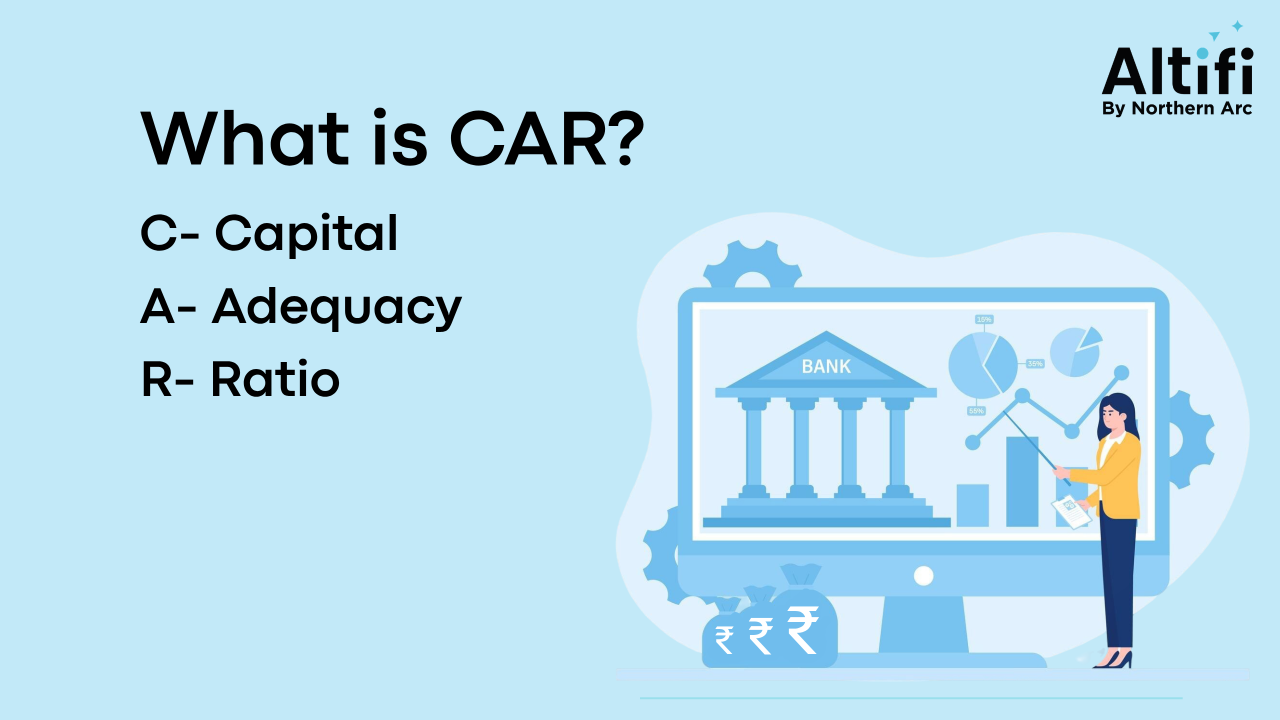
The CAR full form is Capital Adequacy Ratio. It is an important financial metric that calculates the financial strength and stability of all banks. This ratio ensures that the institution has enough funds to handle potential losses. RBI has made it compulsory to maintain a minimum CAR level to maintain sustainability in the banking system and reduce the risk of bank failures. For instance, banks in India are required to have a current CAR as 9%.
Capital Adequacy Ratio Meaning
The capital adequacy ratio is a financial measure that evaluates a bank’s capital in relation to its risk-weighted assets. This ratio ensures that banks maintain a particular amount to handle potential losses and protect depositors. For example, let’s say a bank with a total capital of 100 crore and risk-weighted assets of 1,000 crore. In this case, the CAR would be 10%. This implies that the bank will save 10% capital in case of any risks. An increase in CAR will tell one that the financial position is stronger, whereas a decrease in CAR suggests increased risk and reduced loss absorbability.
What is the Capital Adequacy Ratio Formula?
CAR is the ratio of total capital of the bank to its weighted risk assets. It is the capacity of the bank to manage financial stress and unexpected loss. The capital adequacy ratio formula is:
CAR = (Bank’s Capital / Risk-Weighted Assets) × 100
Total Capital of the Bank
Total capital represents the financial resources a bank holds to absorb losses. It is broadly divided into Tier 1 and Tier 2 capital.
- Includes equity capital, retained earnings, and reserves
- Acts as a financial cushion during losses
- Ensures long-term solvency of the bank
Risk-Weighted Assets (RWA)
Risk-weighted assets are a bank’s assets adjusted for risk levels. Different assets carry different risk weights based on their likelihood of default.
- Loans have higher risk weights compared to government securities
- Helps assess the true risk exposure of a bank
- Forms the denominator in CAR calculation
Components of Capital Adequacy Ratio
The CAR ratio is made up of different capital components that determine a bank’s financial strength.
Tier 1 Capital
Tier 1 capital is the core capital of a bank and is used to absorb losses without ceasing operations.
- Includes equity share capital and retained earnings
- Provides primary financial strength
- Essential for maintaining operational stability
Tier 2 Capital
Tier 2 capital acts as supplementary capital and provides additional protection in times of financial stress.
- Includes subordinated debt and revaluation reserves
- Absorbs losses in case of liquidation
- Less secure compared to Tier 1 capital
Risk-Weighted Assets
Risk-weighted assets play a crucial role in determining the CAR.
- Assigns risk levels to different asset classes
- Ensures capital adequacy is aligned with risk exposure
- Helps regulators monitor bank stability
Why Capital Adequacy Ratio is Important
The CAR is essential for maintaining trust, stability, and efficiency in the banking system.
Financial Stability of Banks
- Ensures banks can absorb unexpected losses
- Reduces the risk of insolvency
- Maintains confidence in the banking system
Protection for Depositors and Investors
- Safeguards depositor funds
- Provides confidence to investors
- Minimises risk of bank failures
Regulatory Requirements (Basel Norms)
Global frameworks such as the Basel Committee on Banking Supervision set minimum CAR requirements.
- Ensures uniform banking standards worldwide
- Strengthens risk management practices
- Promotes financial discipline among banks
Capital Adequacy Ratio and the Banking System
The CAR plays a central role in shaping the functioning and stability of the banking sector.
Role of the Reserve Bank of India
The Reserve Bank of India monitors and regulates CAR requirements in India.
- Sets minimum capital requirements for banks
- Conducts regular supervision and audits
- Ensures compliance with global standards
Basel III Capital Requirements
The Basel III framework strengthens capital requirements for banks.
- Focuses on higher-quality capital
- Introduces stricter risk management norms
- Enhances resilience during financial crises
How CAR Affects Credit Markets and Investors
The Capital Adequacy Ratio has a direct impact on lending, investment decisions, and overall financial market stability.
Impact on Bank Lending
The CAR has a direct impact on the amount of loans that a bank can lend. Increased CAR in a bank implies that the bank is holding a high capital buffer with regard to its risk exposure. Conversely, a reduced CAR can drive the banks to lend more to earn more returns and this can result at times in making risky credit decisions.
Impact on Bond Investors
To bond investors, CAR is a valuable measure of the financial status and creditworthiness of a bank. A bank that has a high CAR will be more stable and will be less prone to default on its attachment, hence its bonds will be more attractive to investors. The result of this confidence is that there is more demand in the bonds of the bank thus lowering the yield to relatively low.
Impact on Financial Stability
CAR plays a critical role in ensuring stability in the general financial system. It minimises the risk of bank failures and financial crisis by making sure that banks have enough capital. A robust CAR structure would absorb shocks in periods of economic recession preventing the shaking of the banking system.
Conclusion
Capital Adequacy Ratio (CAR) is an important measurement of the financial stability and risk management of a bank. Regulators, such as the Reserve Bank of India, ensure security by making sure that banks hold enough capital in relation to their risk-weighted assets to ensure their stability and safeguard depositors. CAR not only contributes towards lending and investor confidence but also enhances the stability of the banking system as a whole. To an investor, the knowledge of CAR is useful in the determination of the safety, performance, and sustainability of a bank.
FAQs on Capital Adequacy Ratio
What is the capital adequacy ratio (CAR)?
The Capital Adequacy Ratio (CAR) is a financial ratio used to determine the capital of a bank with respect to risk-weighted bank assets so that it will be able to absorb the possible losses and would still be in good financial health.
How is the capital adequacy ratio calculated?
CAR can be determined by the formula: CAR = (Total Capital/ Risk-Weighted Assets) x 100. It indicates the ratio of the capital a bank has that will be used to cover its risk exposure.
What are Tier 1 and Tier 2 capital in the CAR framework?
The capital that is considered as the core capital of a bank is the tier 1 capital that consists of equity and retained earnings, the capital that can absorb the losses without interrupting the operations of the bank. Tier 2 capital refers to the extra capital, i.e. subordinated debt, reserves, etc., which is available in case of financial stress.
Why is the capital adequacy ratio important for banks?
The importance of CAR is that it guarantees adequate capitalist banks to manage risks and to protect depositors and assure a stable financial system.
What is the minimum capital adequacy ratio required for banks in India?
Reserve bank of India mandates banks in India with minimum CAR which is 9% in addition to other buffers according to Basel III requirements.
Disclaimer
The information contained in this newsletter (“Newsletter”) is for general informational purposes only. Northern Arc Capital Limited (“Northern Arc”) does not make any warranties about the completeness, reliability, and accuracy of this information. Any action you take upon the information contained in this Newsletter is strictly at your own risk, and Northern Arc will not be liable for any losses and damages in connection with the use of our Newsletter.
The data included in this Newsletter has been obtained from sources that are believed to be reliable and accurate at the time of publication. However, Northern Arc does not guarantee the accuracy or completeness of any information, nor does it assume any responsibility or liability for any errors or omissions therein. Any opinions expressed herein are subject to change without notice and Northern Arc is under no obligation to update or keep current the information contained in this Newsletter.
This Newsletter is not intended to constitute, and should not be construed as, investment advice or a recommendation to purchase, sell, or hold any security or to engage in any investment strategy or transaction. Readers should not rely solely on the information provided in this Newsletter for making investment decisions and should conduct their own due diligence or seek the advice of a qualified professional.
The content of this Newsletter is for informational purposes only and is not a solicitation or an offer to buy or sell any securities or financial instruments. Northern Arc is not responsible for any investment decisions made by the recipients of this Newsletter. Readers should take independent financial advice from a qualified professional in connection with, or independently research and verify, any information that is provided in this Newsletter and wish to rely upon, whether for the purpose of making an investment decision or otherwise.
Northern Arc and its affiliates, directors, employees, and agents expressly disclaim any and all liability for any direct or indirect losses, damages, or expenses of any kind arising out of or relating to the use of this Newsletter, including but not limited to, any losses related to the accuracy, completeness, timeliness, or reliability of such information.
This Newsletter may contain forward-looking statements that are based on current expectations, estimates, forecasts, and projections about the markets in which Northern Arc operates, as well as management’s beliefs and assumptions. Forward-looking statements are not guarantees of future performance and involve certain risks and uncertainties, which are difficult to predict. Past performance is not indicative of future results.
This report is intended solely for the recipient and is not for further circulation. Any distribution, modification, reproduction, or disclosure of the contents of this Newsletter, in whole or in part, without the prior written consent of Northern Arc, is strictly prohibited.