For a long time, fixed deposits have been the "safe
choice" for Indian savers. Parents told them to do it, grandparents
trusted them, and banks pushed them as the best low-risk investment. And for a
long time, they did what they were supposed to do.
But as we get closer to 2024, a lot of investors are starting to pose a good
question:
Are fixed deposits still good?
With inflation lowering the value of money, interest rates
going up and down, and financial goals become harder to reach, standard bank
FDs often don't provide genuine growth. Fixed deposits may still be useful, but
they may not be the best strategy to develop or secure your money anymore.
The Good News?
You don't have to make hazardous or difficult investments to
become ahead.
There are other fixed-income options outside fixed deposits that can give you
higher rates, better cash flow, or more freedom while still being safe.
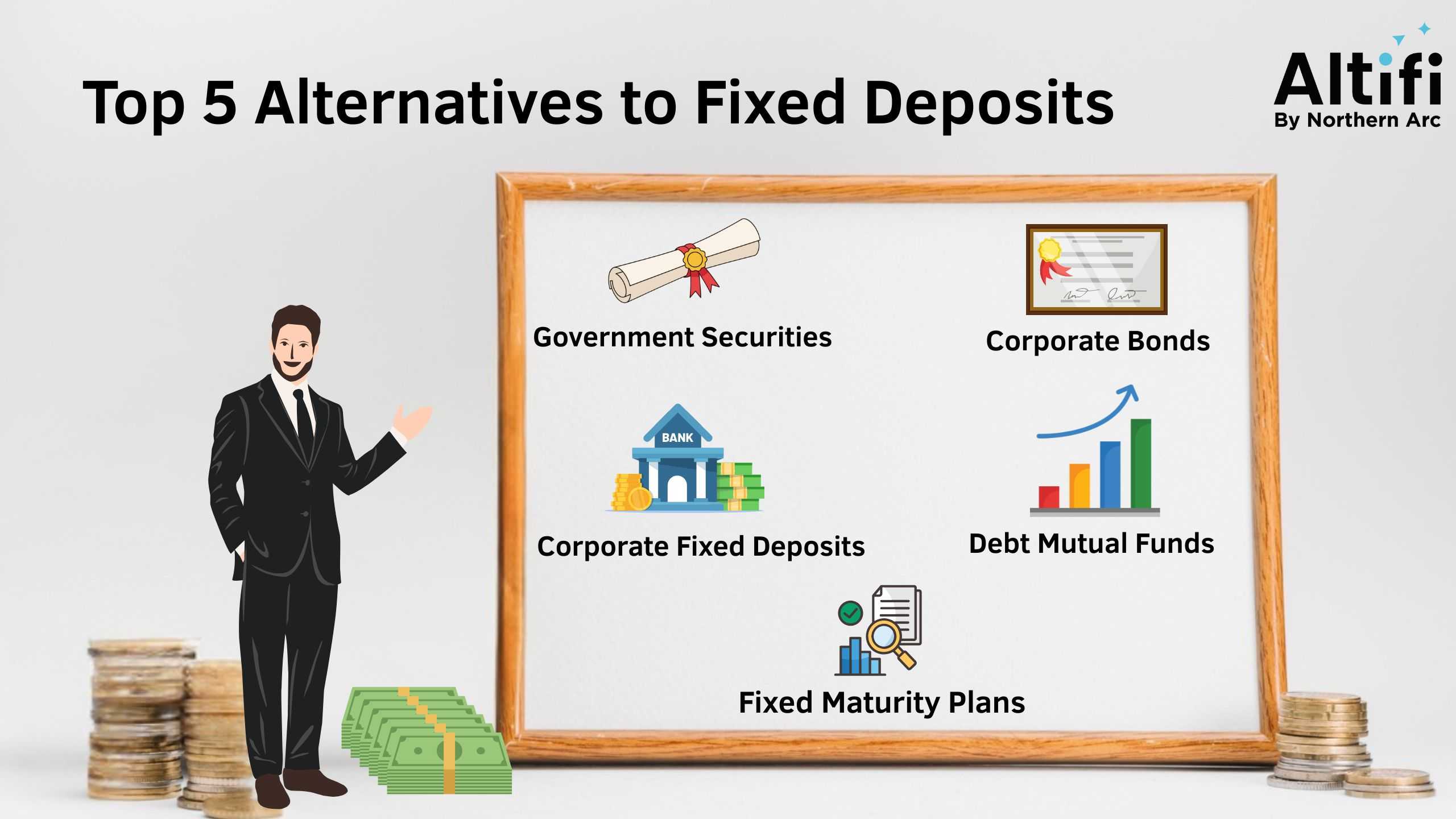
This paper lists five good alternatives to fixed deposits in
2024, explains how they operate, who they are suitable for, and how you can
utilize them as part of a balanced investing strategy.
Why Should You Look Beyond Fixed Deposits in 2024?
It's crucial to know why a lot of investors are changing
their minds about FDs before looking at other options:
- Returns often barely beat inflation
- Interest income is fully taxable
- Long lock-ins reduce flexibility
- Limited wealth-building potential over long periods
Fixed deposits are still a good way to protect your money
and store it for a short time. But for investors who want greater long-term
results, alternatives can be very helpful.
1. G-Secs (Government Securities)
A very good alternative to bank FDs
The central government issues Government securities as a way to borrow money to pay for its operations. When you buy a G-Sec, you are basically lending money to the government and getting interest payments in return.
Why G-Secs are a good option instead of FDs
- Extremely high safety – backed by sovereign guarantee
- Predictable interest payouts (usually semi-annual)
- Wide range of tenures – from short-term Treasury Bills to long-dated bonds
- Yields that often match or exceed bank FD rates
Many government bonds can be traded, which means you're not
always stuck until they mature, unlike fixed deposits.
Best suited for:
- Conservative investors
- Retirees seeking stable income
- Long-term planners prioritising capital protection
In 2024, government bonds will provide a great base for a
low-risk fixed-income portfolio.
2. Corporate Bonds
Higher income with measured risk
Companies issue Corporate bonds to get
money. In exchange, investors get fixed interest payments at set times until
the investment matures.
The issuer's credit quality, tenure, and market circumstances all affect the
returns.
Why corporate bonds beat traditional FDs
- Higher interest rates compared to bank deposits
- Regular income options (monthly, quarterly, or annual)
- Tradable instruments, offering better liquidity than FDs
- Wide range of risk-return profiles
Corporate bonds with high ratings (AA or AAA) are frequently
a solid compromise between safety and yield.
Best suited for:
- Investors seeking predictable cash flow
- Those comfortable evaluating credit quality
- Investors looking to upgrade returns without equity exposure
Corporate bonds can significantly improve income potential when selected thoughtfully.
3. Fixed Deposits for Businesses
Familiar structure, better yields
Corporate
fixed deposits look and feel similar to bank FDs, but they are issued
by companies rather than banks. Because they don’t carry the same regulatory
structure as bank deposits, they often offer higher interest rates.
Why investors consider corporate FDs
- Better returns than most bank FDs
- Flexible tenures, typically from 1 to 5 years
- Cumulative and non-cumulative options
- Simple investment structure
The main distinction is the risk of credit. The issuer's
financial strength is very important for corporate FDs.
Best suited for:
- Yield-focused conservative investors
- Short- to medium-term financial goals
- Investors willing to diversify across issuers
4. Mutual Funds for Debt
Professional management and flexibility go hand in hand.
Debt mutual funds
put money into a mix of government bonds, corporate bonds, and money market
instruments. They don't guarantee a return like fixed deposits do, but they do
offer more flexibility and options.
Why debt funds are strong FD alternatives
- Potentially higher post-tax efficiency
- No fixed lock-in (for most categories)
- Easy liquidity
- Professionally managed portfolios
Many people who invest in debt funds use Systematic
Withdrawal Plans (SWPs) to get monthly payments, just like FD interest
payments.
Best suited for:
- Investors seeking liquidity
- Medium-term financial goals
- Tax-aware investors
- Those comfortable with mild market fluctuations
When you pick debt mutual funds depending on how long you
plan to hold them and how much risk you're willing to take, they work best.
5. Fixed Maturity Plans (FMPs)
Predictability without the usual FD limits
Fixed Maturity Plans are debt plans that invest in assets
that will mature at the same time as the fund itself. This structure lowers the
risk of interest rates and makes it easier to estimate returns.
Why FMPs are good alternatives to FD
- Aligned maturity reduces volatility
- More predictable outcomes
- Often higher yields than bank FDs
- Suitable for goal-based investing
than regular deposits, but you have to keep your money
locked up until maturity.
Best suited for:
- Investors with defined time horizons
- Short- to medium-term goals
- Those seeking stability with better returns
How to Pick the Best FD Alternative
Instead of asking “Which option gives the highest return?”, ask:
- How much risk can I tolerate?
- When will I need this money?
- Do I need regular income or long-term growth?
- How important is liquidity?
Smart strategy for 2024:
- Diversify across instruments
- Stagger maturities using laddering
- Balance safety and yield
- Avoid chasing returns blindly
What Altifi Does:
Altifi helps investors compare fixed-income options in a straightforward, organized fashion, which makes it easier to look at returns, risks, tenures, and if the option is a good fit for them without using too much jargon.
Altifi makes it easier for investors who want to go beyond
standard fixed deposits while still sticking to fixed-income discipline to do
their research and make decisions.
Questions That Are Often Asked (FAQs)
1. Do fixed deposits still matter in 2024?
Yes. FDs are still good for keeping your money secure and
meeting short-term demands, but other options can give you better total
returns.
2. Which FD option is the safest?
Government bonds are usually thought to be the safest,
followed by business bonds with excellent ratings.
3. Is it possible to make money every month without FDs?
Yes. Corporate bonds, some debt funds, and non-cumulative
corporate FDs all pay out regularly.
4. Are mutual funds that invest in debt risky?
They are risky in the market, but if you choose the right
ones, they are usually less volatile than equities funds.
5. Should I get rid of all my FDs and get anything else?
No, a blend that is balanced works best. FDs are still
important in a portfolio that has a lot of different types of investments.
Conclusion:
Fixed deposits will always be useful in Indian homes. They
give you peace of mind, stability, and predictability. But in 2024, prudent
investing means growing, not replacing.
Investors can:
• Get better returns
• Keep things safe
• Increase liquidity
• Make your portfolios stronger
The idea isn't to get rid of fixed deposits; it's to use them with better
instruments that fit today's financial needs.
Disclaimer:
The information contained in this Article (“Article”) is for general informational purposes only. Northern Arc Capital Limited (“Northern Arc”) does not make any warranties about the completeness, reliability, and accuracy of this information. Any action you take upon the information contained in this Article is strictly at your own risk, and Northern Arc will not be liable for any losses and damages in connection with the use of our Article.
The data included in this Article has been obtained from sources that are believed to be reliable and accurate at the time of publication. However, Northern Arc does not guarantee the accuracy or completeness of any information, nor does it assume any responsibility or liability for any errors or omissions therein. Any opinions expressed herein are subject to change without notice and Northern Arc is under no obligation to update or keep current the information contained in this Article.
This Article is not intended to constitute, and should not be construed as, investment advice or a recommendation to purchase, sell, or hold any security or to engage in any investment strategy or transaction. Readers should not rely solely on the information provided in this Article for making investment decisions and should conduct their own due diligence or seek the advice of a qualified professional.
The content of this Article is for informational purposes only and is not a solicitation or an offer to buy or sell any securities or financial instruments. Northern Arc is not responsible for any investment decisions made by the recipients of this Article. Readers should take independent financial advice from a qualified professional in connection with, or independently research and verify, any information that is provided in this Article and wish to rely upon, whether for the purpose of making an investment decision or otherwise.
Northern Arc and its affiliates, directors, employees, and agents expressly disclaim any and all liability for any direct or indirect losses, damages, or expenses of any kind arising out of or relating to the use of this Article, including but not limited to, any losses related to the accuracy, completeness, timeliness, or reliability of such information.
This Article may contain forward-looking statements that are based on current expectations, estimates, forecasts, and projections about the markets in which Northern Arc operates, as well as management’s beliefs and assumptions. Forward-looking statements are not guarantees of future performance and involve certain risks and uncertainties, which are difficult to predict. Past performance is not indicative of future results.
This report is intended solely for the recipient and is not for further circulation. Any distribution, modification, reproduction, or disclosure of the contents of this Article, in whole or in part, without the prior written consent of Northern Arc, is strictly prohibited.