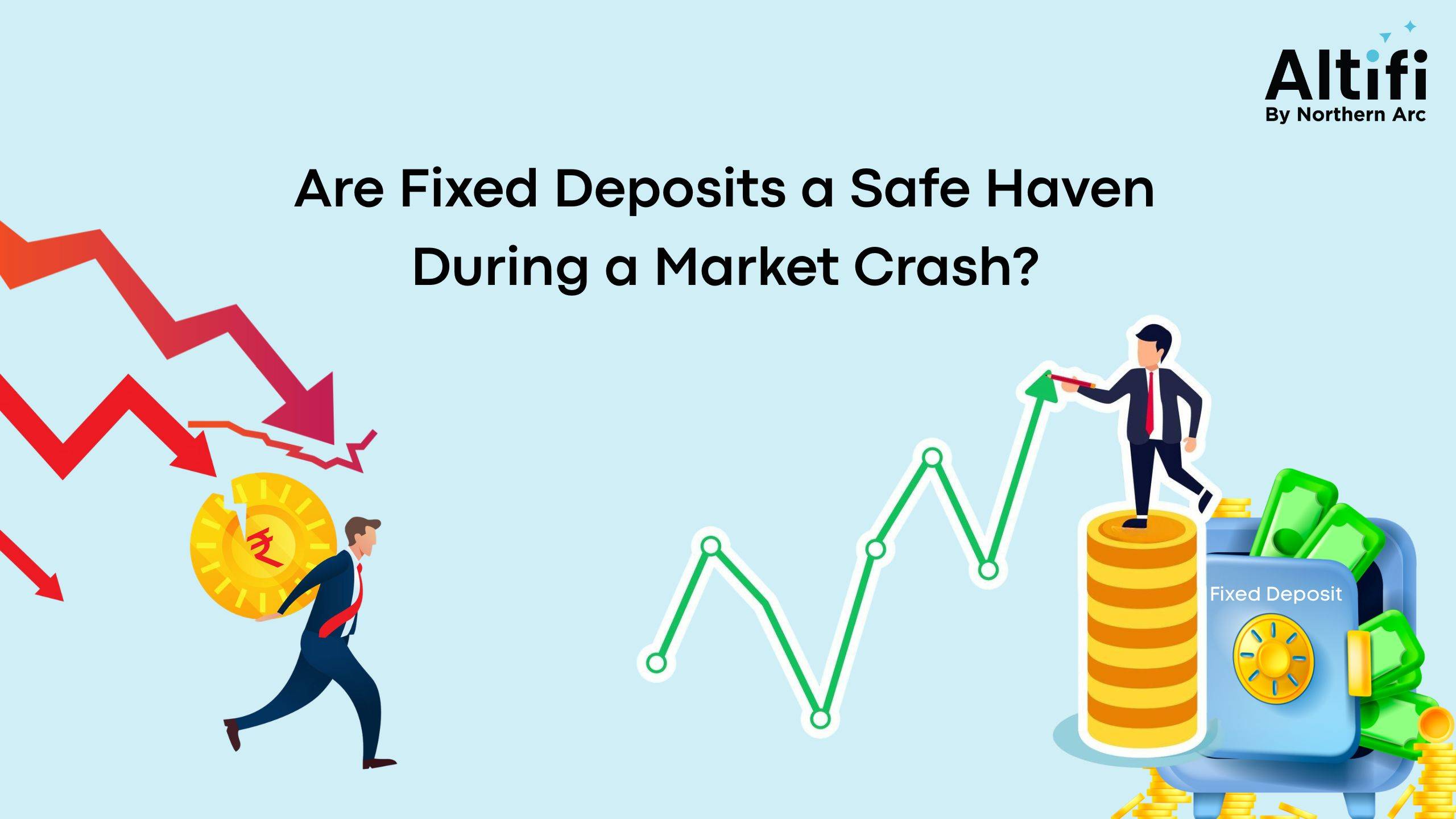
Introduction: When markets go down, feelings go up.
Market crashes don't just test portfolios; they also test your faith. Even for
experienced investors, it can be scary to see stock values drop so quickly.
Headlines get louder, red figures take over trade screens, and people start to
feel uncertain.
A lot of investors naturally look for protection in situations like these. The fixed
deposit (FD) is one of the most typical places to go. Fixed deposits are
typically viewed as a safe place to put money during times of market volatility
since they are stable and offer predictable returns.
But are fixed deposits really a safe place to put your money amid a market
crash? And if they are safe, do they come with no downsides?
To answer that, you need to know what fixed deposits do and don't do.
Key Takeaways
- Fixed deposits provide capital stability and predictable returns.
- They are insulated from stock market volatility.
- Inflation risk can reduce real returns over time.
- Moving entirely to FDs during a crash may result in opportunity cost.
A balanced allocation strategy often works better than
extreme shifts.
Why Investors Go to Fixed Deposits When the Market
Crashes
Market downturns typically happen due to:
- Economic slowdowns
- Rising interest rates
- Geopolitical tensions
- Overvaluation corrections
- Financial crises
During these times, the stock market might drop quickly. For
a lot of investors, the main worry changes from growing to protecting their
money.
Fixed deposits appear attractive because:
- Principal remains stable
- Returns are pre-determined
- No daily price fluctuations
- Deposit insurance coverage exists within prescribed limits
The Deposit Insurance and Credit Guarantee Corporation (DICGC) protects qualified bank deposits in India up to ₹5 lakh for each depositor at each bank. This gives depositors even more peace of mind.
When things get more volatile, the fact that fixed returns
are certain might be comforting.
What Fixed Deposits Are and What They Offer
Banks and certain other financial institutions provide fixed
deposit as a way to save money. It lets people put money in for a set
amount of time at a set interest rate.
Key Features:
- Fixed interest rate
- Defined tenure
- Capital protection (subject to issuer stability)
- Penalty for premature withdrawal
FDs don't change based on how the market feels, unlike
stocks. The value doesn't go down when the stock index changes.
But they do have some drawbacks, even though they make things more stable.
The Emotional Response vs. the Strategic Choice
A lot of financial decisions are based on feelings during a crash.
If you sell your stocks and move all of your money to FDs, you may feel less anxious right away. But when you plan your investments, you need to think about how they will affect you in the long run.
In the past, markets have bounced back from downturns.
Equity markets have shown that they can bounce back over lengthy periods of
time, even when timing is different.
Shifting entirely to fixed deposits during a crash may mean:
- Locking in low interest rates
- Missing eventual market recovery
- Reducing long-term wealth accumulation potential
So, it's crucial to know the difference between emotional
comfort and strategic allocation.
Inflation Risk: The Quiet Erosion
One of the biggest limitations of fixed deposits is inflation risk.
If:
- FD interest rate = 6.5%
- Inflation = 6%
The real return (after inflation) is very low.
If inflation is higher than FD rates, your buying power goes
down over time.
Inflation may stay high during times of economic uncertainty because of supply
shocks or government actions. In these situations, FDs protect nominal capital
but may not protect actual wealth completely.
The Missed Recovery: The Cost of Opportunity
Recoveries typically happen after market crashes.
Investors who exit equities completely and remain in fixed deposits may:
- Miss lower valuation entry points
- Miss rebound gains
- Lock in lower growth trajectory
This doesn't mean that fixed deposits are bad. They just
have different uses.
When to Use Fixed Deposits During a Market Crash
In certain cases, Fixed
deposits can be helpful:
1. Short-Term Money Goals
If you need money in 1 to 3 years, equity volatility might
not be the best option. FDs provide you peace of mind.
2. Setting aside money for emergencies
An emergency fund should put liquidity and capital
protection ahead of growth.
3. Very little desire for risk
If volatility makes you stressed up about money or makes you
make rash decisions, putting some of your money into FDs can help your
portfolio act more consistently.
4. The Peak of Interest Rates
It might make sense to lock in good FD rates if interest
rates are high.
What Diversification Does
Instead of an all-or-nothing shift, diversification often provides balance.
For example:
- A portion in fixed income (including FDs)
- A portion in large-cap equities
- A portion in growth-oriented assets
This allows:
- Stability from fixed income
- Participation in recovery from equities
- Balanced risk exposure
Diversification reduces reliance on a single outcome.
FD Laddering: A Useful Plan
Laddering spreads deposits among multiple maturities instead of putting all of your money into one long-term FD.
Example:
Instead of placing ₹5 lakh in a single 5-year FD, allocate:
- ₹1 lakh in 1-year FD
- ₹1 lakh in 2-year FD
- ₹1 lakh in 3-year FD
- ₹1 lakh in 4-year FD
- ₹1 lakh in 5-year FD
Benefits include:
- Periodic liquidity
- Reduced interest rate risk
- Opportunity to reinvest at prevailing rates
- Avoidance of premature withdrawal penalties
FD laddering can be particularly useful during uncertain rate cycles.
Cycles of Interest Rates and Fixed Deposits
The central bank's policy, the degree of inflation, and the state of the economy all have an effect on interest rates.
When central banks cut rates to stimulate growth during downturns:
- FD rates may decline
- New deposits may earn lower returns
Putting money into FDs before rate drops can help keep greater yields. But it's
hard to always guess how rates will move.
Alternative Fixed-Income Options
While fixed deposits are common, they are not the only low-risk instruments.
Other regulated fixed-income instruments may include:
- Government bonds
- Treasury bills
- Corporate bonds
- Debt mutual funds (subject to market risk)
Platforms such as Altifi provide access to structured fixed-income instruments, allowing investors to evaluate risk, tenure, and yield in a transparent manner.
But each instrument has its own set of features and level of
danger.
Finding The Right Balance Between Growth And Stability
The main question is not if fixed deposits are safe.
They usually are, as long as the issuer is trustworthy and the limits are met.
A better question is:
Are fixed deposits sufficient for long-term wealth preservation during
inflationary environments?
The answer depends on:
- Time horizon
- Financial goals
- Risk tolerance
- Existing portfolio allocation
Common Misunderstandings
1. "FDs Guarantee Wealth Growth"
FDs promise nominal returns, but not always growth that
keeps up with inflation.
2. "Markets Always Destroy Wealth When They Crash"
Crashes lower values for a short time. Long-term results
rely on how people recover and how disciplined investors are.
3. "Best Means Safe"
Safety protects wealth, but it could also limit how much money you can make.
A Fair Point of View
Fixed deposits serve an important role:
- Capital preservation
- Income stability
- Psychological comfort
But giving up growth assets completely could cause problems
in the long run.
Instead of moving quickly when the market goes down, organized allocation
planning could lead to better results.
Questions that are often asked (FAQs)
1. Are fixed deposits absolutely safe when the market crashes?
The stock market doesn't effect fixed deposits. But safety relies on how stable
the issuer is and how much deposit insurance covers.
2. Do fixed deposits help protect against inflation?
Not always. If inflation is higher than FD returns, your buying power could go
down.
3. Should I put all of my money into FDs during a crash?
The time frame and goals of an investment affect the choices made. Switching
completely to FDs may lower the possibility for long-term growth.
4. What does it mean to "FD ladder"?
To control liquidity and interest rate risk, FD laddering means distributing
deposits across multiple maturities.
5. Is it possible for stock markets to bounce back after a crash?
Markets have historically rebounded over extended timeframes, although the
timing of recovery differs.
Conclusion
When the market crashes, fixed deposits can help keep things stable. They provide stability and protection from changes in the stock market.
But safety alone doesn't mean that your buying power will
stay the same over time.
A balanced approach that combines both stability and growth assets may help you
deal with both risk and opportunity.
Instead of asking if fixed deposits are a safe place to put your money, it could be better to ask:
How much safety do you need in your portfolio compared to
your long-term goals?
The answer is to think about how to use the resources instead of just reacting.
Disclaimer:
The information contained in this Article (“Article”) is for general informational purposes only. Northern Arc Capital Limited (“Northern Arc”) does not make any warranties about the completeness, reliability, and accuracy of this information. Any action you take upon the information contained in this Article is strictly at your own risk, and Northern Arc will not be liable for any losses and damages in connection with the use of our Article.
The data included in this Article has been obtained from sources that are believed to be reliable and accurate at the time of publication. However, Northern Arc does not guarantee the accuracy or completeness of any information, nor does it assume any responsibility or liability for any errors or omissions therein. Any opinions expressed herein are subject to change without notice and Northern Arc is under no obligation to update or keep current the information contained in this Article.
This Article is not intended to constitute, and should not be construed as, investment advice or a recommendation to purchase, sell, or hold any security or to engage in any investment strategy or transaction. Readers should not rely solely on the information provided in this Article for making investment decisions and should conduct their own due diligence or seek the advice of a qualified professional.
The content of this Article is for informational purposes only and is not a solicitation or an offer to buy or sell any securities or financial instruments. Northern Arc is not responsible for any investment decisions made by the recipients of this Article. Readers should take independent financial advice from a qualified professional in connection with, or independently research and verify, any information that is provided in this Article and wish to rely upon, whether for the purpose of making an investment decision or otherwise.
Northern Arc and its affiliates, directors, employees, and agents expressly disclaim any and all liability for any direct or indirect losses, damages, or expenses of any kind arising out of or relating to the use of this Article, including but not limited to, any losses related to the accuracy, completeness, timeliness, or reliability of such information.
This Article may contain forward-looking statements that are based on current expectations, estimates, forecasts, and projections about the markets in which Northern Arc operates, as well as management’s beliefs and assumptions. Forward-looking statements are not guarantees of future performance and involve certain risks and uncertainties, which are difficult to predict. Past performance is not indicative of future results.
This report is intended solely for the recipient and is not for further circulation. Any distribution, modification, reproduction, or disclosure of the contents of this Article, in whole or in part, without the prior written consent of Northern Arc, is strictly prohibited.