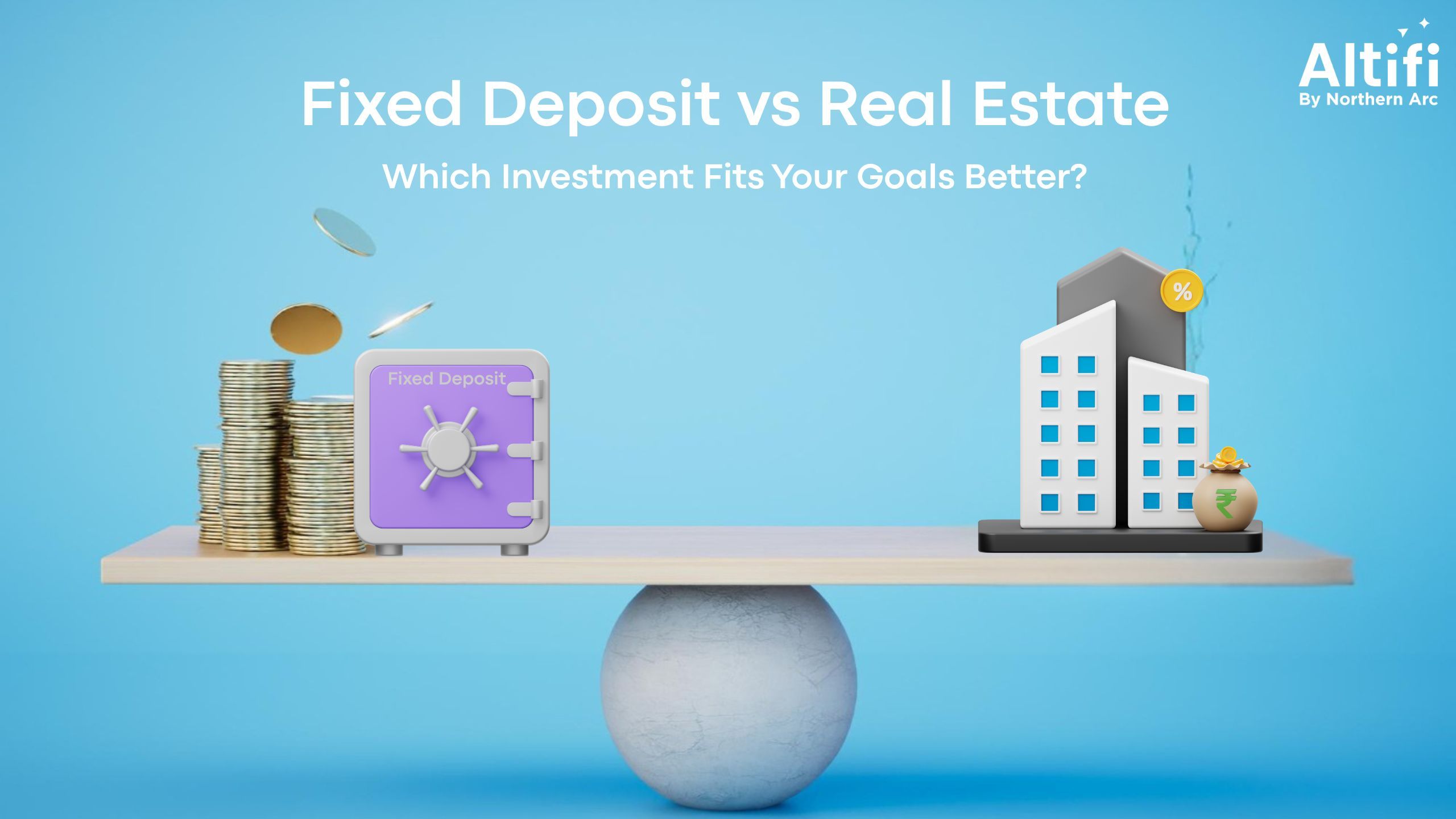
Choosing an investment in real estate vs fixed deposit is essential for investors seeking stability, growth, or a balance of both. Each option offers distinct advantages. FDs provide assured returns and high liquidity, while real estate offers long-term appreciation and potential rental income. The appropriate choice depends on factors like risk tolerance, investment horizon, and financial goals. Understanding how these two asset classes differ can help you make a more informed decision aligned with your long-term wealth-building strategy.
What is a Fixed Deposit?
In India, FDs have relatively higher interest rates than saving accounts and help in investing a certain amount of money over a period of time. FDs are governed by RBI rules and have two forms: cumulative and non-cumulative FDs. They may also be ordinary, tax-saving, corporate, or special FDs. The interest is payable on a monthly or quarterly basis for non-cumulative FDs, whereas cumulative FDs have interest payable on maturity. The interest rate may also be affected by tenure and market conditions, which may result in negative returns if inflation is more than the interest rate offered. Also, after one year, any profit up to one lakh is subject to tax, which may affect the returns on investment based on the tax slab.
What is Real Estate Investment?
Real estate investment refers to the process of investing in land or houses with an aim to generate wealth and income. It entails activities like buying and owning properties, renting or selling them to earn a profit. The real estate market offers various advantages to investors.
Position, locality, and connectedness are some of the elements that determine property values and liquidity. When you sell, broking reduces your profit margin. However, owners also incur maintenance expenses, or deal with issues like unlawful encroachment, etc.
Fixed Deposits vs Real Estate
The table below summarises the core differences between FD vs property investment across seven key parameters.
Parameter | Fixed Deposit | Real Estate |
Risk Level | Low — DICGC-insured up to ₹5 lakh | Medium to High — market, location, and regulatory risk |
Minimum Investment | As low as ₹1,000 (some banks) | Depends on location (metro city, town, rural areas etc) |
Liquidity | High — premature withdrawal within days | Low — sale takes 3 to 12 months |
Tax Efficiency | TDS on interest; taxed at slab rate | LTCG at 12.5% (after 2 years); rental income taxed at slab |
Regulatory Oversight | RBI-regulated, DICGC-insured | RERA-regulated (varies by state) |
Note: FD interest rates are indicative as of April 2025 and vary by bank and tenure. Real estate returns are historical averages and vary by city and micro-market. Past performance does not guarantee future results.
How Does FD Compare to Real Estate?
Returns are usually the first factor investors consider when weighing FD vs real estate. Here’s a comparison between the two.
Fixed Deposit Returns
FD interest rates in India currently range from 6% to 8.10% per annum for general depositors, depending on the bank and tenure. Some small finance banks and corporate deposits offer rates up to 9% p.a., though corporate FDs carry additional credit risk. Senior citizens can earn an extra 0.25% to 0.50% on top of the standard rate.
FD returns are predictable. The rate is locked in at the time of deposit, and there is no risk of earning less than the agreed amount (unless the depositor opts for premature withdrawal, which typically attracts a certain penalty).
Real Estate Returns
The NHB RESIDEX data shows that residential property in Indian metropolitan areas has experienced annual value growth between 8 percent and 12 percent during the last ten years. The appreciation rate in Tier-2 cities reaches only 5 percent to 8 percent per year. The return on each property investment depends on three factors which include its location and the builder's reputation and nearby infrastructure developments.
The rental income generates additional annual gross returns which range from 2 percent to 4 percent based on property appreciation. The net rental yield usually falls between 1.5 percent and 2.5 percent after property owners deduct their maintenance costs and vacancy times and property tax expenses.
Liquidity: How Easily Can Investors Access Their Money?
Liquidity measures how quickly an investment can be converted to cash without losing significant value. This parameter alone can determine which option suits an investor better.
FD Liquidity
Fixed deposits offer high liquidity. Most banks allow premature withdrawal within 1 to 3 working days. There is a penalty — typically a certain percentage of reduction from the applicable interest rate — but the principal remains fully intact.
Some banks also permit partial withdrawal or offer an overdraft/loan against the FD (up to 90% of the deposit value), which means the FD continues to earn interest while the investor gets access to funds.
Real Estate Liquidity
Selling a property is a slow process. Finding a buyer, negotiating the price, completing legal due diligence, registering the sale deed, and receiving payment can take anywhere from 3 to 12 months. In a slow market, it can take longer.
There is no partial withdrawal option with real estate. For instance, you cannot sell a portion of the flat. If funds are needed urgently, the only option is a loan against property, which has its own processing time and interest cost.
Practical Implication
If an investor might need the money within the next 1 to 3 years — for a medical emergency, child's education, or a career change — an FD is clearly the more practical choice. Real estate is suitable only when the investor can commit to a 7+ year holding period without needing to liquidate.
Tax Implications: Real Estate vs Fixed Deposit
Tax treatment plays a significant role in the actual, post-tax return from any investment. Both FDs and real estate have distinct tax structures under the Income Tax Act.
Factor | FD | Real Estate |
Tax on returns | Slab rate on interest | LTCG at 12.5% (if held 2+ years) |
TDS | 10% if interest > ₹40,000/year | Not applicable |
Section 80C benefit | Yes (5-year tax-saver FD only) | Yes (on home loan principal repayment) |
Section 24(b) benefit | Not applicable | Yes (up to ₹2 lakh deduction on home loan interest) |
Note: Interest rates subject to change. TDS applicable as per IT rules. Tax benefits are subject to provisions of the Income Tax Act and may change based on amendments.
Which Investment Fits Specific Goals?
Different financial goals suit different investments. Here are three simple profiles:
Profile 1: FD Is the Better Fit
- Suitable for short-term goals (1–5 years)
- Ideal for ₹5–10 lakh investments
- Offers guaranteed returns, high liquidity, and low risk
- FD laddering can improve flexibility
Profile 2: Real Estate is the Better Fit
- Best for long-term goals (7–10+ years)
- Requires higher capital (₹50 lakh+)
- Offers potential appreciation and rental income
- Suitable for investors who can handle low liquidity
Profile 3: A Mixed Approach
- Combines safety and growth
- Example: Allocate part to FDs for liquidity and part to real estate for long-term returns
- Helps balance risk and accessibility
Conclusion
Deciding between FD vs real estate needs careful assessment of various factors. Investors must determine which one fits their timeline, capital, and risk tolerance. Fixed deposits suit short- to medium-term goals where capital safety and liquidity matter most. Real estate tends to suit long-term wealth creation for investors who can commit significant capital for a very long duration. A thorough analysis of all aspects can help decide the suitable investment option in the long run.
FAQs
1. Which is safer: FD or real estate?
FDs are safer. They are regulated by the RBI and insured up to ₹5 lakh, while real estate carries market and location risks.
2. Is FD better for short-term goals?
Yes, FDs may suit 1–5 year goals due to stable returns and high liquidity. Real estate can be better for long-term investing.
3. What is the TDS rate on FD interest?
10% if interest exceeds ₹40,000 (₹50,000 for senior citizens). Without PAN, it is 20%.
4. Which gives better returns: FD or property?
Real estate may offer higher returns over time, but FDs provide fixed and predictable returns.
5. What is the minimum investment?
FDs start from around ₹1,000, while real estate usually requires ₹20 lakh or more.
6. Which is more liquid?
FDs are highly liquid. Real estate can take months to sell.
7. Is real estate a good investment in 2025–2026?
It can be, but returns depend on location and time horizon. FDs remain a stable alternative.
Disclaimer:
The information contained in this Article (“Article”) is for general informational purposes only. Northern Arc Capital Limited (“Northern Arc”) does not make any warranties about the completeness, reliability, and accuracy of this information. Any action you take upon the information contained in this Article is strictly at your own risk, and Northern Arc will not be liable for any losses and damages in connection with the use of our Article.
The data included in this Article has been obtained from sources that are believed to be reliable and accurate at the time of publication. However, Northern Arc does not guarantee the accuracy or completeness of any information, nor does it assume any responsibility or liability for any errors or omissions therein. Any opinions expressed herein are subject to change without notice and Northern Arc is under no obligation to update or keep current the information contained in this Article.
This Article is not intended to constitute, and should not be construed as, investment advice or a recommendation to purchase, sell, or hold any security or to engage in any investment strategy or transaction. Readers should not rely solely on the information provided in this Article for making investment decisions and should conduct their own due diligence or seek the advice of a qualified professional.
The content of this Article is for informational purposes only and is not a solicitation or an offer to buy or sell any securities or financial instruments. Northern Arc is not responsible for any investment decisions made by the recipients of this Article. Readers should take independent financial advice from a qualified professional in connection with, or independently research and verify, any information that is provided in this Article and wish to rely upon, whether for the purpose of making an investment decision or otherwise.
Northern Arc and its affiliates, directors, employees, and agents expressly disclaim any and all liability for any direct or indirect losses, damages, or expenses of any kind arising out of or relating to the use of this Article, including but not limited to, any losses related to the accuracy, completeness, timeliness, or reliability of such information.
This Article may contain forward-looking statements that are based on current expectations, estimates, forecasts, and projections about the markets in which Northern Arc operates, as well as management’s beliefs and assumptions. Forward-looking statements are not guarantees of future performance and involve certain risks and uncertainties, which are difficult to predict. Past performance is not indicative of future results.
This report is intended solely for the recipient and is not for further circulation. Any distribution, modification, reproduction, or disclosure of the contents of this Article, in whole or in part, without the prior written consent of Northern Arc, is strictly prohibited.