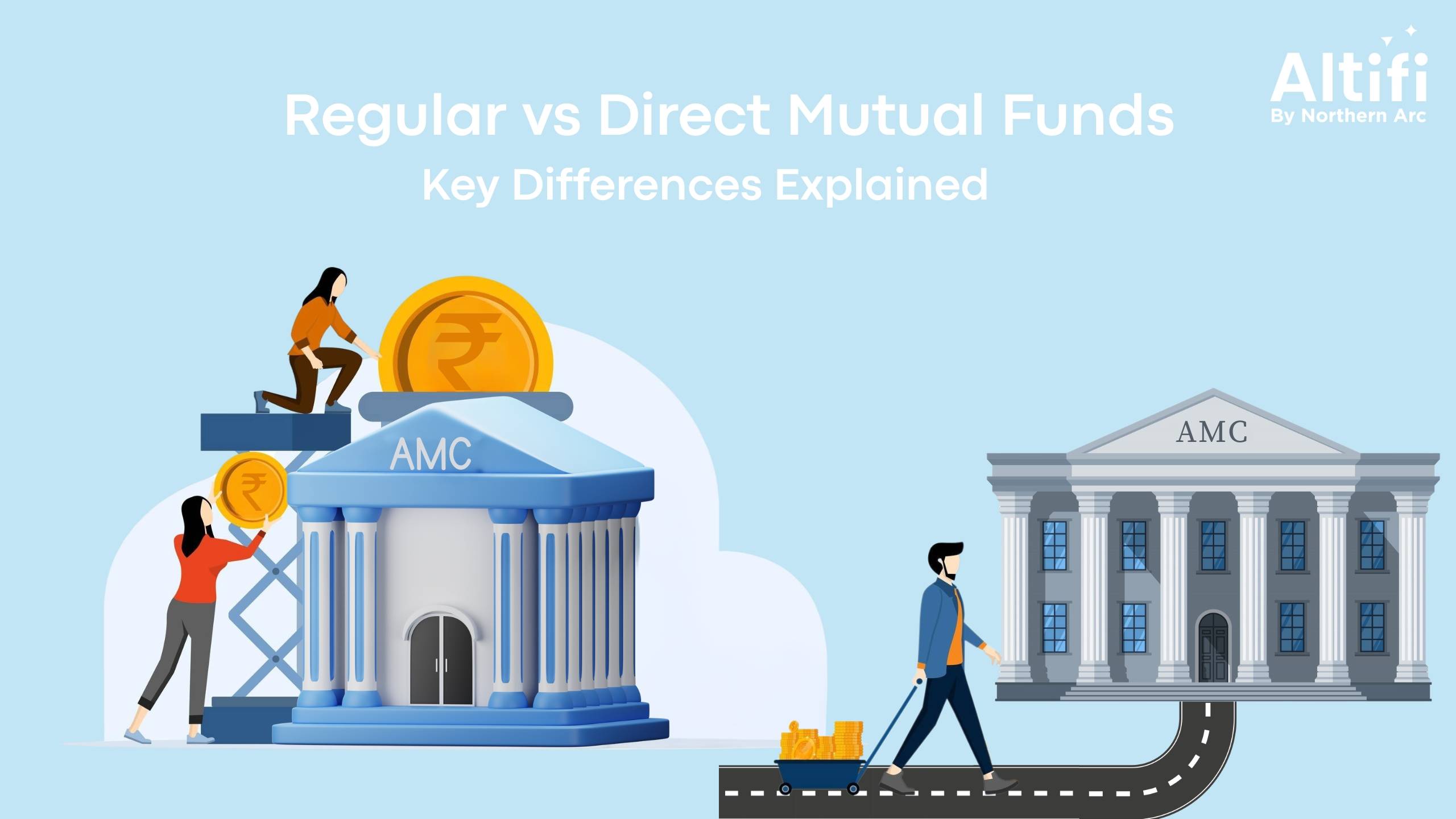
Regular and direct mutual funds refer to two different types of investments in the same mutual fund schemes. The main difference between them is how they are purchased and the costs involved in them. In a regular plan, the investments are done through intermediaries such as brokers or distributors, whereas in a direct plan, investors invest directly with the fund house. Understanding the difference between regular and direct mutual fund can help investors select a cost-effective route for investments. This article explains what is difference between direct and regular mutual fund.
What are Direct Mutual Funds?
Direct mutual funds are plans in which the investors invest in the mutual fund company (AMC) without the services of any broker, distributor, or agent. These plans are cheaper as there is no middleman, and this may result in relatively large returns in the long term.
Example: If you invest ₹1 lakh directly through an AMC website in a fund with a 1% expense ratio, you save on distributor commissions. Over time, this lower cost can increase your overall returns compared to regular plans.
How Direct Mutual Funds are Purchased
Direct mutual funds can be bought via the asset management company's website, mobile applications, or direct investing platforms. The investors are required to fill KYC, choose the scheme, and invest without involvement of any third party.
Expense Ratio in Direct Plans
Direct plans are less expensive due to a low expense ratio, as there are no distributor commissions. Such a cost advantage is directly proportional to the net returns of the investors over time, particularly in the long-term investment.
What are Regular Mutual Funds?
Regular mutual funds are those plans whereby investments are made via the intermediaries like brokers, financial advisors or distributors. These intermediaries facilitate the investors in the selection of the scheme, documentation and support.
Example: If you invest ₹1 lakh in the same fund through an advisor, the expense ratio may be 1.8% instead of 1%. The extra 0.8% goes towards the distributor’s commission, which slightly reduces your net returns over time.
Role of Intermediaries
The intermediaries provide a connection between the investor and the mutual fund company. They offer advisory services, recommend appropriate funds, and assist in managing the investment process particularly to a beginner or one who requires guidance.
Expense Ratio in Regular Plans
Regular plans have a higher expense ratio as they include commissions paid to intermediaries. This additional cost reduces the overall returns compared to direct plans, particularly over longer investment horizons.
Key Differences Between Regular and Direct Mutual Funds
| Parameter | Direct Mutual Funds | Regular Mutual Funds |
|---|---|---|
| Investment Mode | Invested directly through AMC | Invested via broker/distributor |
| Intermediary Involvement | No intermediary involved | Involves agents, brokers, or advisors |
| Expense Ratio | Lower expense ratio | Higher expense ratio (includes commission) |
| Returns | Higher (due to lower costs) | Slightly lower (due to higher expenses) |
| Advisory Support | No advisory support | Professional guidance available |
| Transparency | High transparency | Moderate transparency |
| Suitability | Suitable for experienced investors | Suitable for beginners or those needing assistance |
| Long-Term Wealth Impact | Better wealth accumulation | Slightly lower accumulation |
Advantages and Disadvantages of Direct Mutual Funds
Direct mutual funds are suitable for investors who prefer a cost-efficient and self-managed investment approach. Here are the advantages and disadvantages of direct mutual funds.
| Advantages of Direct Mutual Funds | Disadvantages of Direct Mutual Funds |
|---|---|
| Lower expense ratio due to no distributor commission | No professional guidance or advisory support |
| Potential for higher net returns over time | Requires knowledge to select suitable funds |
| Greater transparency in charges and portfolio | Risk of incorrect investment decisions |
| Full control over investment choices | Requires regular monitoring and review |
| Direct interaction with the AMC | Can be complex for first-time investors |
Advantages and Disadvantages of Regular Mutual Funds
Regular mutual funds are ideal for investors who prefer guidance and support throughout their investment journey. Here are the advantages and disadvantages of regular mutual funds.
| Advantages of Regular Mutual Funds | Disadvantages of Regular Mutual Funds |
|---|---|
| Professional guidance from advisors | Higher expense ratio due to commissions |
| Easy investment process and support | Lower net returns over time |
| Help with portfolio management | Advice may be biased at times |
| Suitable for first-time investors | Less control over investment decisions |
How to Identify a Direct or Regular Mutual Fund
It is important to correctly identify whether a fund is direct or regular before investing.
Scheme Name Indicator
Direct plans are clearly labeled with the word “Direct” in the scheme name, while regular plans do not include this term.
Expense Ratio Difference
Direct plans have a lower expense ratio compared to regular plans. Comparing expense ratios in fund documents or platforms helps distinguish between the two.
Choosing Between Direct and Regular Mutual Funds
The choice between direct and regular mutual funds depends on the investor’s knowledge, involvement level, and need for assistance.
Experience Level of Investor
Experienced investors who understand markets and fund selection may prefer direct plans, while beginners may benefit from regular plans.
Need for Advisory Support
Investors who require professional advice and portfolio monitoring may opt for regular plans, whereas those comfortable managing investments independently may choose direct plans.
How to Invest in Direct or Regular Mutual Funds
The investment process differs based on whether an intermediary is involved.
Investing in Direct Mutual Funds
Investors can invest directly through the AMC’s website, mobile apps, or platforms offering direct plans by completing KYC, selecting schemes, and making payments online.
Investing in Regular Mutual Funds
Investments are made through brokers, financial advisors, or distributors who assist with KYC, scheme selection, and transaction execution.
Conclusion
Regular and direct mutual funds are two different ways of investing in the same mutual fund schemes. The major difference between these two is cost and the medium of investing. By removing intermediaries, direct plans are cheaper in terms of expense ratio and have the possibility of greater long-term returns. Regular plans offer professional advice and convenience of investment. The decision between the two must be made according to the experience of an investor and the need to have an advisor, as selecting the appropriate option will enhance the overall investment performance.
FAQs on Regular vs Direct Mutual Funds
What is the difference between regular and direct mutual funds?
Regular mutual funds are purchased through intermediaries, while direct mutual funds are bought directly from the AMC, resulting in lower costs.
Why do direct mutual funds offer higher returns than regular plans?
Direct plans have lower expense ratios as they exclude distributor commissions, which improves net returns over time.
Are direct mutual funds better than regular mutual funds?
Direct funds are cost-efficient, but regular funds are better for investors who need guidance and support.
How can I check if my mutual fund is a direct or regular plan?
Check the scheme name for the word “Direct” or compare the expense ratio in the fund details.
Can I switch from a regular mutual fund to a direct mutual fund?
Yes, switching is possible by redeeming from the regular plan and investing in the direct plan of the same scheme.
Do direct mutual funds have lower expense ratios than regular plans?
Yes, direct mutual funds generally have lower expense ratios due to the absence of intermediary commissions.
Who should invest in regular mutual funds?
Investors who need professional advice, portfolio management, or assistance in selecting funds should consider regular plans.
Are direct mutual funds suitable for beginners?
They can be suitable if beginners are comfortable researching and managing investments on their own.
How do distributors earn commission from regular mutual funds?
Distributors earn commissions through a portion of the expense ratio charged in regular mutual fund plans.
Can I invest in both direct and regular mutual funds at the same time?
Yes, investors can hold both types simultaneously, depending on their investment strategy and preferences.
Disclaimer
The information contained in this newsletter (“Newsletter”) is for general informational purposes only. Northern Arc Capital Limited (“Northern Arc”) does not make any warranties about the completeness, reliability, and accuracy of this information. Any action you take upon the information contained in this Newsletter is strictly at your own risk, and Northern Arc will not be liable for any losses and damages in connection with the use of our Newsletter.
The data included in this Newsletter has been obtained from sources that are believed to be reliable and accurate at the time of publication. However, Northern Arc does not guarantee the accuracy or completeness of any information, nor does it assume any responsibility or liability for any errors or omissions therein. Any opinions expressed herein are subject to change without notice and Northern Arc is under no obligation to update or keep current the information contained in this Newsletter.
This Newsletter is not intended to constitute, and should not be construed as, investment advice or a recommendation to purchase, sell, or hold any security or to engage in any investment strategy or transaction. Readers should not rely solely on the information provided in this Newsletter for making investment decisions and should conduct their own due diligence or seek the advice of a qualified professional.
The content of this Newsletter is for informational purposes only and is not a solicitation or an offer to buy or sell any securities or financial instruments. Northern Arc is not responsible for any investment decisions made by the recipients of this Newsletter. Readers should take independent financial advice from a qualified professional in connection with, or independently research and verify, any information that is provided in this Newsletter and wish to rely upon, whether for the purpose of making an investment decision or otherwise.
Northern Arc and its affiliates, directors, employees, and agents expressly disclaim any and all liability for any direct or indirect losses, damages, or expenses of any kind arising out of or relating to the use of this Newsletter, including but not limited to, any losses related to the accuracy, completeness, timeliness, or reliability of such information.
This Newsletter may contain forward-looking statements that are based on current expectations, estimates, forecasts, and projections about the markets in which Northern Arc operates, as well as management’s beliefs and assumptions. Forward-looking statements are not guarantees of future performance and involve certain risks and uncertainties, which are difficult to predict. Past performance is not indicative of future results.
This report is intended solely for the recipient and is not for further circulation. Any distribution, modification, reproduction, or disclosure of the contents of this Newsletter, in whole or in part, without the prior written consent of Northern Arc, is strictly prohibited.