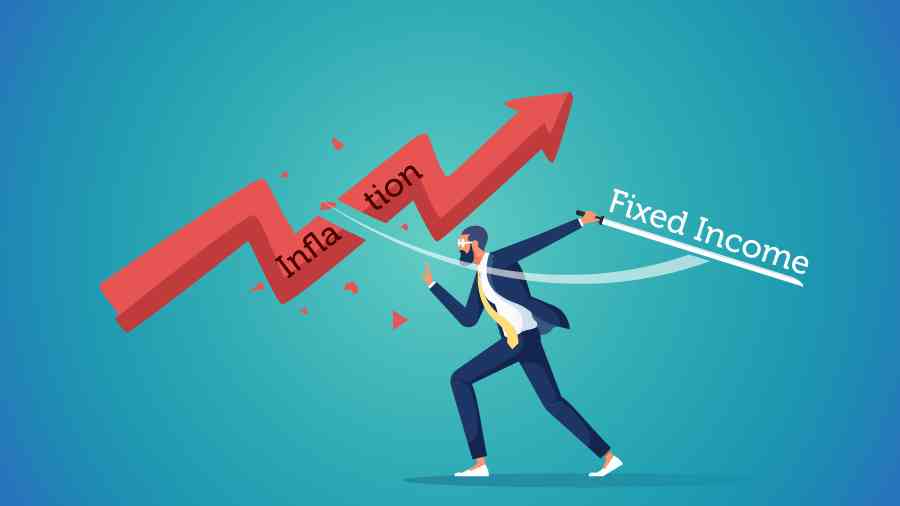
Inflation is an important factor that may influence the real value of savings and investment returns over time. As the prices of goods and services increase, the value of money over time may gradually decline, making it important to evaluate investments not only on nominal returns but also on inflation-adjusted outcomes. For investors who prefer fixed-income investments, inflation can affect the real value of interest payments and maturity proceeds. Understanding how inflation interacts with fixed-income products, taxation, real yield, and portfolio construction may support a more informed assessment of investment decisions and long-term financial planning.
Inflation Impacts Budgets
While rising inflation puts pressure on central banks to raise interest rates, slow down economies and sends negative signals to equity markets, at the same time rising prices have a direct impact on households and their savings, especially their debt income. Inflation may affect household budgets, especially if one is dependent on interest income earned on a fixed corpus.
As inflation raises its fangs, initially households would try to adjust by cost-cutting and reducing consumption. However, if inflation remains sticky, there is a gradual erosion in the value of capital. Real returns on the fixed income keep shrinking if inflation rises at a pace higher than the increase in interest rates on the debt instruments that investors have invested.
How Inflation Reduces Purchasing Power
Inflation is the gradual increase in the prices of goods and services over time, which can reduce the real value of money. As prices rise, the same amount of money may buy fewer goods and services than before. This erosion in the value of money can affect savings and fixed-income investments, as the real returns generated by these investments may decline during periods of elevated inflation.
Impact on Fixed Income Investors
Inflation may influence the real value of returns received from fixed income investments. Fixed payments from bonds or similar instruments may appear unchanged, rising prices can reduce the real value of these cash flows over time. During periods of inflation, investors may assess whether investment returns are keeping pace with rising prices.
Understanding Net Yield
When evaluating fixed-income investments during periods of inflation, it is important to look beyond the stated bond yield. Inflation can reduce the real value of investment returns, meaning the actual benefit retained by an investor may be lower than the nominal return generated by the bond.
This is where real yield becomes relevant. Real yield represents the return remaining after adjusting for inflation and may provide a clearer picture of the value retained from bond returns over time. It is generally calculated by subtracting the inflation rate from the bond yield.
What is Real Yield in Bond Investing?
Real yield refers to the return remaining after adjusting for inflation. It may indicate how inflation affects the real value of returns received from a bond investment. If inflation rises above nominal returns, the value retained from those returns may decline over time. Understanding real yield may support a clearer assessment of inflation-adjusted bond performance.
How Inflation Affects Bond Returns
Inflation may affect bond returns by reducing the real value of fixed payments of fixed payments over time. Rising inflation may also influence interest rates, which may affect bond prices in secondary markets. Bonds with comparatively lower fixed returns may experience increased inflation-related pressure during periods of elevated inflation.
Taxation Impact
However, that is not the end of the story. Taxation may further reduce the effective returns received by investors. As the interest paid on the bond is taxable for the investor, the yield may decline further, depending on the investor’s tax slab. Also, in the shorter term, where most investors are invested, the yields may be negative (rate of inflation more than the bond yield) and hence it becomes a tough call for investors. Also, with commercial banks’ fixed deposit rate of 5.5-6 per cent per annum, the real rate of return remains negative at current inflation.
Why Taxation Matters for Bond Investors
Taxation may influence the value retained from bond-related payments and gains. Tax treatment may differ depending on the type of investment and applicable regulations. Understanding taxation may support a broader assessment of inflation-adjusted and post-tax returns from fixed income investments.
Portfolio Diversification
Let's understand how a portfolio of different kinds of fixed income products can help inflation. The right mix of fixed income investments can change the scenario for them. To generate positive real yield, investors may either invest in high coupon bonds or have to look for tax efficient fixed income avenues.
Importance of Asset Allocation
Asset allocation refers to distributing investments across different asset categories. During inflationary periods, diversification across investment types may influence overall portfolio exposure to changing economic conditions. Asset allocation may also support a balanced approach to fixed income and other investment categories.
Balancing Risk and Returns in Fixed Income
Fixed income investments may carry different levels of risk and return depending on tenure, issuer profile, and market conditions. Inflation may influence the purchasing power of returns over time. Evaluating risk and returns may support a more informed understanding of fixed income investments.
Tax Planning
Let’s look at the tax efficient fixed income investments first. These include Employees' Provident Fund (EPF) and Public Provident Fund (PPF). While PPF currently pays nearly 7.1 percent annual interest, EPF corpus generally earns around 8.1 percent. Both products are tax exempt at the contribution, accrual and withdrawal stage, provided subscribers are well within the norms. However, after recent amendments, if EPF contributions exceed Rs 2.5 lakh in a financial year, the interest earned on the excess contribution can be taxable. PPF allows up to Rs 1.5 lakh of investment per year, while investors can raise their EPF contribution through the Voluntary Provident Fund (VPF) route. Over a long period of time, it has been seen that the rate of interest on these avenues are generally higher than the rate of inflation and the tax-free status is an additional characteristic that investors may consider.
EPF and PPF as Tax-Efficient Fixed Income Options
Employees’ Provident Fund (EPF) and Public Provident Fund (PPF) are savings-linked instruments that may be considered while evaluating tax-efficient fixed income categories. Tax-related benefits and fixed return structures may influence how these instruments are assessed alongside inflation and post-tax considerations.
Higher Coupon Bonds
Looking at some of the higher interest-bearing bonds too can help investors. Savvy investors handle this situation in two ways. First is to invest in avenues that pay comparatively higher yields for the same level of risk. Same is the case with some retail avenues backed (directly or indirectly) by sovereign. For example, National Saving Certificate (backed by sovereign) generally offers 6.8% which is higher than 5.65% offered by banks on a five-year FD. The idea here is to indicate that without taking extra credit risk, extra returns may be earned. The ultimate decision is that of the investor depending on their financial goals, cash flows needs and asset allocation among others.
Why Investors May Prefer Higher Yield Bonds During Inflation
During periods of inflation, investors often look for bond options that may offer relatively higher yields to help offset the impact of rising prices on purchasing power. Higher yield bonds can attract attention because the additional income may improve inflation-adjusted return expectations compared with lower-yielding fixed income instruments. However, investors should also consider credit risk, interest rate sensitivity, and overall portfolio goals before making investment decisions.
Understanding Risk-Return Trade-Off in Bonds
The risk-return trade-off in bonds explains an important principle of fixed income investing: bonds that offer higher potential returns may also involve higher levels of risk. For example, higher yield bonds may provide better income potential during inflation, but they can also carry greater credit risk, interest rate risk, or liquidity risk compared with highly rated government securities or top-rated corporate bonds. Investors often compare yield with issuer quality, tenure, repayment capacity, and market conditions before making decisions. Understanding the bond risk-return trade-off may help investors assess whether a higher yield adequately compensates for the additional risk involved.
Company Bonds
Another way to boost returns is to build a diversified portfolio of bonds of well-managed companies. These companies may not have the highest credit rating but may offer higher returns compared to the highest rated bond offerings. These lower-rated bonds offer comparatively higher yields compared to government securities and AAA rated offerings. Investors who can tolerate some risk may add such bonds to their portfolios from time to time. They can also utilise the services of bond platforms that offer curated bonds, which have been diligence by experts. However, one must be careful on the allocation. One’s entire capital should not be invested in these bonds and the exposure should be diversified across multiple such bonds.
Diversified Corporate Bond Portfolios
A diversified corporate bond portfolio may include bonds issued by different companies, sectors, or credit categories. Diversification may influence exposure to issuer-specific risks and market movements. Portfolio structure may also be reviewed while assessing inflation and fixed return expectations.
Role of Credit Ratings in Bond Investing
Credit ratings may indicate the repayment capacity and financial position of a company or issuer. Credit Rating Agencies evaluate issuers and assign ratings that may reflect varying levels of credit risk. It is important for investors to evaluate ratings while reviewing bond-related risks and repayment capacity.
Why Investors Explore Corporate Bonds for Higher Yields
Corporate bonds may attract attention when investors compare available yields across fixed income investments. Relatively higher yields may be evaluated against inflation, taxation, and credit-related considerations. Such comparisons may form part of a broader fixed income assessment.
Factors Investors Should Consider Before Investing in Bonds
The following are a few factors that investors may consider before investing in bonds.
Investment Horizon
Investment horizon refers to the period for which an investment may be maintained. Bond tenure and return expectations may be evaluated alongside investment duration and liquidity-related considerations.
Liquidity Needs
Liquidity needs refer to how quickly access to invested amounts may be required. Some bonds may have different levels of market liquidity, which may influence investment-related decisions and access to funds.
Risk Appetite
Risk appetite refers to the level of risk an investor may tolerate while investing. Factors such as credit quality, market conditions, and return expectations may influence bond-related risk assessment.
Conclusion
Inflation, taxation, real yield, credit quality, and liquidity may influence how fixed income investments are evaluated over time. Bond-related returns may be reviewed alongside purchasing power, post-tax value, and market conditions. Factors such as tenure, risk tolerance, and asset allocation may also influence investment assessment. Understanding these considerations may support a broader view of inflation-adjusted and fixed income investment evaluation.
FAQs
What is real yield in bond investing?
Real yield refers to returns remaining after inflation adjustment, which may indicate how purchasing power changes over an investment period.
Why does inflation affect bond returns?
Inflation may reduce the purchasing power of fixed payments, which may influence the real value of bond-related returns.
Why does taxation matter in fixed income investments?
Taxation may affect the retained value of returns, which may influence post-tax assessment of fixed income investments.
What is the role of credit ratings in bond investing?
Credit ratings may indicate repayment capacity and financial position, which may support evaluation of bond-related credit risk.
Why is liquidity important when evaluating bonds?
Liquidity may influence how quickly invested amounts can be accessed, depending on market conditions and bond availability.
Disclaimer:
The information contained in this Article (“Article”) is for general informational purposes only. Northern Arc Capital Limited (“Northern Arc”) does not make any warranties about the completeness, reliability, and accuracy of this information. Any action you take upon the information contained in this Article is strictly at your own risk, and Northern Arc will not be liable for any losses and damages in connection with the use of our Article.
The data included in this Article has been obtained from sources that are believed to be reliable and accurate at the time of publication. However, Northern Arc does not guarantee the accuracy or completeness of any information, nor does it assume any responsibility or liability for any errors or omissions therein. Any opinions expressed herein are subject to change without notice and Northern Arc is under no obligation to update or keep current the information contained in this Article.
This Article is not intended to constitute, and should not be construed as, investment advice or a recommendation to purchase, sell, or hold any security or to engage in any investment strategy or transaction. Readers should not rely solely on the information provided in this Article for making investment decisions and should conduct their own due diligence or seek the advice of a qualified professional.
The content of this Article is for informational purposes only and is not a solicitation or an offer to buy or sell any securities or financial instruments. Northern Arc is not responsible for any investment decisions made by the recipients of this Article. Readers should take independent financial advice from a qualified professional in connection with, or independently research and verify, any information that is provided in this Article and wish to rely upon, whether for the purpose of making an investment decision or otherwise.
Northern Arc and its affiliates, directors, employees, and agents expressly disclaim any and all liability for any direct or indirect losses, damages, or expenses of any kind arising out of or relating to the use of this Article, including but not limited to, any losses related to the accuracy, completeness, timeliness, or reliability of such information.
This Article may contain forward-looking statements that are based on current expectations, estimates, forecasts, and projections about the markets in which Northern Arc operates, as well as management’s beliefs and assumptions. Forward-looking statements are not guarantees of future performance and involve certain risks and uncertainties, which are difficult to predict. Past performance is not indicative of future results.
This report is intended solely for the recipient and is not for further circulation. Any distribution, modification, reproduction, or disclosure of the contents of this Article, in whole or in part, without the prior written consent of Northern Arc, is strictly prohibited.